Expat Pension Advice in Singapore: The Ultimate Guide to Retirement Schemes
Post date:


Key Takeaways
- Expat pension advice in Singapore helps foreigners build retirement security beyond CPF, using flexible tools like the Supplementary Retirement Scheme (SRS) and offshore pension plans to achieve long-term, tax-efficient growth.
- Starting early and diversifying investments are key pillars of effective expat pension planning, allowing your savings to compound, access global investment opportunities, and stay protected across currencies and markets.
- With expert expat pension advice from BlueAlpha Capital, expatriates can navigate complex tax rules, structure portable pension plans, and create a personalised financial roadmap that aligns with their global lifestyle and future goals.
Understanding the Pension System In Singapore
Singapore’s pension system is one of the most structured and financially disciplined models in Asia, designed to encourage long-term savings and self-reliance during retirement. Rather than relying on a single state-funded pension, the system integrates both mandatory and voluntary schemes that collectively form a sustainable approach to retirement planning.
The pension system in Singapore is built on two main pillars:
- Central Provident Fund (CPF) – a mandatory savings plan for Singapore citizens and permanent residents (PRs).
- Supplementary Retirement Scheme (SRS) – a voluntary scheme that is open to both locals and expatriates working in Singapore.
These two programs together represent the cornerstone of Singapore’s national pension framework, ensuring that both citizens and expats can prepare financially for retirement through structured contributions and tax incentives.
- The Central Provident Fund (CPF)
The CPF was established in 1955 and is managed by the Ministry of Manpower (MOM). It serves as the foundation of the national pension in Singapore and functions as a compulsory savings and social security program.
Both employees and employers contribute monthly to the CPF, with the contribution rates depending on the worker’s age. As of 2025, the contribution structure remains consistent with 2023 figures:
| Age | Employee Contribution | Employer Contribution |
| 55 or below | 20% | 17% |
| 55–60 | 16% | 15% |
| 60–65 | 10.5% | 11.5% |
| 65–70 | 7.5% | 9% |
| Above 70 | 5% | 7.5% |
Funds contributed to CPF are allocated to three accounts:
- Ordinary Account (OA) – for housing, education, and approved investments
- Special Account (SA) – for retirement savings and long-term investments
- MediSave Account (MA) – for healthcare expenses and insurance
When an individual turns 55, savings from the OA and SA are transferred into a Retirement Account (RA), which is used to provide monthly income in retirement.
At age 65, Singaporeans and PRs can begin receiving their CPF LIFE (Lifelong Income for the Elderly) payouts, a lifetime annuity scheme that guarantees monthly income for as long as they live.
The payout amount depends on the individual’s Retirement Sum tier at age 55:
- Basic Retirement Sum (BRS) – S$102,900
- Full Retirement Sum (FRS) – S$205,800
- Enhanced Retirement Sum (ERS) – S$308,700
For those turning 55 in 2024, these figures apply to the 2025 plan year. CPF LIFE offers payout options such as steady, growing (2% annual increase), or declining payments, allowing members to choose according to their financial goals.
Policyholders who do not enrol in CPF LIFE may instead receive benefits under the Retirement Sum Scheme (RSS), which pays ma onthly income until age 90 or until savings are depleted.
- Supplementary Retirement Scheme (SRS)
Unlike the CPF, the Supplementary Retirement Scheme is voluntary and available to foreigners (expats) as well as Singapore residents. It is administered by three major banks, DBS, OCBC, and UOB, under the supervision of the Ministry of Finance.
Expats can open an SRS account and contribute up to S$35,700 per year (for foreigners, the cap may vary slightly depending on employment status). Contributions are tax-deductible, making it an attractive option for high-income earners looking to reduce their taxable income in Singapore while building retirement savings.
SRS funds can be invested in approved instruments, such as fixed deposits, unit trusts, bonds, ETFs, and insurance products. Withdrawals are typically allowed after age 63, and only 50% of the withdrawn amount is taxable, offering additional tax efficiency for retirees.
- Retirement Age and Legal Framework
As of 2025, the official retirement age in Singapore is 63, set to rise to 65 by 2030. Employers are legally required to offer re-employment options up to age 68 (70 by 2030), giving individuals flexibility to extend their working years.
Pension payouts under CPF start at age 65 (automatically at 70 if unclaimed). Early withdrawals are permitted in special circumstances, such as medical emergencies or reduced life expectancy.
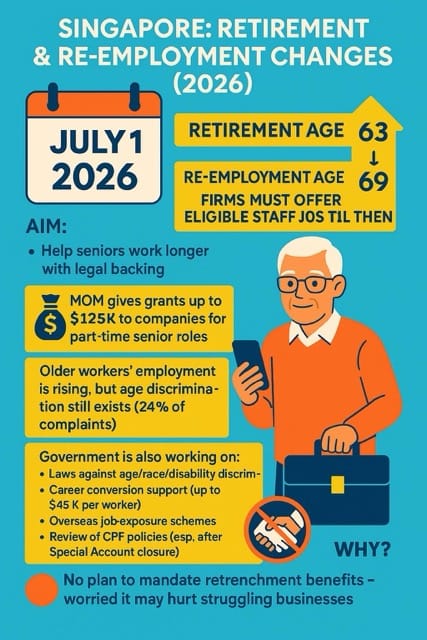
Retirement age changes in Singapore starting from 2026. Source: My Grandfather’s Road
On the other hand, traditional occupational pensions are rare in Singapore due to the comprehensive coverage of the CPF. The Government Pension Scheme for civil servants has been largely phased out, though certain sectors like the armed forces maintain tailored savings and retirement plans under the Savings and Employee Retirement Plan.
- Special Incentives and Housing Schemes
To further enhance retirement security, Singapore offers home-related incentives under the CPF system, including:
- Silver Housing Bonus – up to S$30,000 for seniors who downsize their homes and top up their CPF retirement account.
- Lease Buyback Scheme – allows elderly homeowners to sell part of their home’s lease to the government in exchange for CPF top-ups and cash payouts.
Eligibility typically requires at least one Singapore citizen and a household income below S$14,000 per month.
How Pension Works For Expats In Singapore
For expats, pension or retirement planning means setting up a clear financial strategy that helps maintain your lifestyle after you stop working or wherever you decide to retire.
Unlike locals who benefit from the Central Provident Fund (CPF), expatriates are not automatically enrolled in a state pension.
Instead, they must rely on voluntary schemes like the Supplementary Retirement Scheme (SRS), private pensions, or offshore investment portfolios.
In particular, the SRS is the main avenue for expats to build retirement savings in Singapore. It’s a voluntary savings scheme designed to supplement personal or overseas pension funds.
As its core, retirement planning for expats Singapore focuses on:
- Building a personal pension structure suited to your income, residency status, and long-term plans.
- Leveraging Singapore’s tax-efficient investment environment.
- Coordinating your pension across borders, for example, managing UK, EU, or Australian pensions while residing in Singapore.
This is where professional expat pension advice becomes essential, helping you balance global assets, local rules, and long-term tax efficiency.
The Difference Between Local and Expat Pensions
The biggest distinction in the pension in Singapore lies in eligibility:
| Category | Singapore Citizens & PRs | Foreign Expats |
| CPF (Central Provident Fund) | Mandatory contributions (up to 37% combined from employer & employee) | Not eligible unless granted PR status |
| SRS (Supplementary Retirement Scheme) | Voluntary, up to S$15,300 annual contribution limit | Voluntary, up to S$35,700 annual contribution limit |
| CPF LIFE Retirement Income | Available to CPF members at age 65 | Not available without a CPF membership |
| Private / International Pension Plans | Optional | Often necessary for long-term retirement planning |
In short, foreigners working in Singapore are not covered by the national CPF system unless they become permanent residents. But they can participate in the SRS, which offers generous tax benefits and flexibility for non-residents.
Beyond the SRS, expats have several other ways to secure retirement income in Singapore:
- Voluntary CPF Contributions: Some work pass holders may voluntarily contribute to the CPF if their employers agree, but CPF LIFE payouts only apply to PRs.
- Private Pension Plans: Many employers offer corporate pension schemes through global insurers. These can include defined contribution or offshore pension plans tailored for international mobility.
- Offshore and International Pension Plans: Expats can also explore QROPS (Qualifying Recognised Overseas Pension Schemes) or QNUPS (Qualifying Non-UK Pension Schemes) for managing overseas assets tax-efficiently.
- Investment Portfolios: A mix of diversified global investments (e.g., ETFs, unit trusts, or bonds) can serve as a private retirement fund, especially for those not covered by CPF.
As of 2025, Singapore continues to strengthen its framework for expat pension advice and cross-border financial compliance:
- Retirement Age Adjustment: The statutory retirement age remains 63, but the planned increase to 65 by 2030 is reaffirmed.
- Tax Relief on SRS Contributions: The cap for non-resident foreigners remains at S$35,700, reaffirmed under the 2025 Budget, with continued 50% tax exemption on withdrawals.
- Transparency & Reporting: The Monetary Authority of Singapore (MAS) has updated compliance rules for international pension transfers to ensure proper reporting of cross-border investments.
- Digital Access: Expats can now monitor SRS accounts and CPF voluntary contributions through updated MyMoneySense and CPF online services, improving accessibility and visibility of retirement savings.
These updates reflect Singapore’s goal to maintain flexibility for global professionals while reinforcing transparency and tax compliance.
Practical Expat Pension Advice in Singapore
- Open A Supplementary Retirement Scheme (SRS) Account Early
The SRS is one of the few tax-advantaged savings options available under the Singapore pension for foreigners, offering flexibility, attractive tax benefits, and long-term compounding growth, all essential for building a secure retirement.
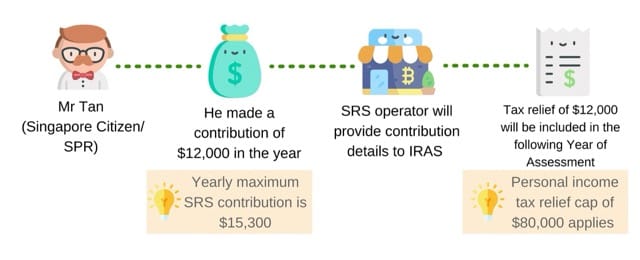
SRS contributions and tax relief explanation. Source: IRAS
One of the smartest steps in retirement planning for expats in Singapore is to open a Supplementary Retirement Scheme (SRS) account as early as possible to receive benefits such as:
- Compound growth: Savings in your SRS account benefit from interest earned on both your principal and accumulated returns, growing exponentially over time.
- Manageable contributions: Starting early means you can save smaller amounts each month rather than making large contributions closer to retirement.
- Tax efficiency: Contributions to SRS are tax-deductible, which reduces your taxable income each year. At retirement, only 50% of withdrawals are taxable, providing long-term savings.
- Retirement flexibility: A larger SRS balance allows you to retire earlier or enjoy more lifestyle choices later in life.
- Peace of mind: Knowing you’re financially prepared brings confidence and stability throughout your career abroad.
For example, take John, an expat who had accumulated S$500,000 in his SRS account by age 63. He invested S$100,000 into a single-premium endowment policy and began receiving payouts at age 73. Even after fully drawing down his SRS account, John continued to enjoy a guaranteed monthly income stream, and 50% of these payouts remained tax-free.
Opening an SRS account is straightforward and can be done through one of the three authorised operators in Singapore: DBS, OCBC, or UOB.
- Choose one of the three approved banks to open your SRS account.
- Complete the SRS Declaration Form if you’re a foreigner.
- Declare your foreigner status annually to maintain the correct contribution cap (currently S$35,700 per year).
- If you later become a Singapore Citizen or Permanent Resident, inform your bank so your new contribution limit can be recalculated.
Once opened, you can start making regular contributions and investing your SRS funds in approved instruments such as unit trusts, bonds, or annuity plans, all within Singapore’s tax-efficient framework.
- Set Up An Offshore Pension Plan
For many internationally mobile professionals, setting up an offshore pension plan is a practical and flexible way to build long-term retirement wealth.
Unlike local schemes such as the SRS, offshore pensions are designed for expats who move frequently between countries and want to keep their savings accessible, tax-efficient, and globally managed.
These plans are particularly suitable for foreigners seeking structured retirement planning for expats in Singapore, as they allow contributions in multiple currencies, such as USD, EUR, or GBP, and often provide access to a wide range of global investment funds.
Contributions can be made from anywhere in the world, making them ideal for expatriates with changing job locations or income sources.
Offshore pension plans offer key advantages:
- Flexibility: You can start, stop, or adjust contributions at any time.
- Global investment access: Choose from diverse, professionally managed funds.
- Favourable tax treatment: Many plans are structured in low-tax jurisdictions, potentially reducing your tax burden.
- Currency choice: Payments and withdrawals can be managed in major currencies, protecting against exchange rate risk.
However, these plans also come with risks, such as exposure to market volatility and potential changes in international tax or pension regulations. Since the value of your investments isn’t guaranteed, it’s essential to assess your risk tolerance and long-term goals before committing.
To get started, expats should first define their retirement objectives, consult an experienced expat pension advisor like BlueAlpha.
- Diversify Investments Beyond Cash Savings
For expats living in Singapore, one of the most practical pieces of expat pension advice is to diversify investments beyond cash savings.
While keeping money in savings accounts offers short-term security, it does little to build long-term wealth, especially in a city where inflation and lifestyle costs can rise quickly.
Singapore’s status as a global financial hub gives expats access to a broad range of investment products.
As long as you are not from a country sanctioned by the Monetary Authority of Singapore (MAS), you can open an investment account locally and start building a portfolio. Expats from countries like the UK, Australia, Hong Kong, Malaysia, and Thailand can invest freely, while Americans face stricter rules due to U.S. tax regulations such as PFIC.
If you’re eligible, it’s smart to take advantage of Singapore’s no capital gains tax policy. This allows you to focus on capital appreciation, investing in global equities, ETFs, bonds, or international pension plans without being taxed locally on your gains.
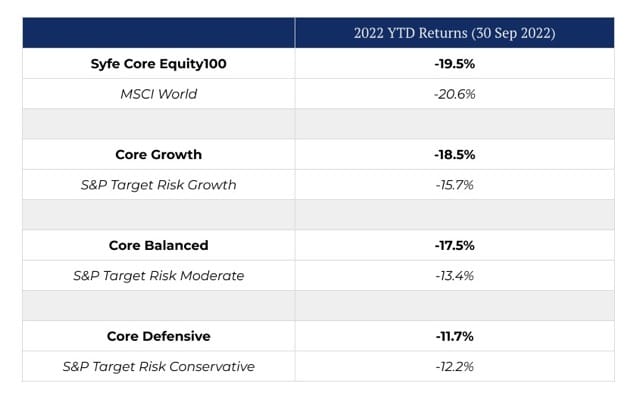
Singaporean investment portfolios in 2022. Source: Syfe
However, always check whether your home country taxes capital gains when you repatriate or relocate, as this can affect when you should realise your profits.
Popular investment options for expats in Singapore include:
- SRS investments: Grow your Supplementary Retirement Scheme funds through ETFs, unit trusts, or government bonds.
- Singapore Savings Bonds (SSBs): Safe and flexible long-term options offering stable returns.
- REITs and ETFs: Diversify across property and global markets for income and growth.
- Wealth management platforms: Automated portfolios like StashAway or Endowus allow easy, low-cost global diversification.
When diversifying, avoid focusing solely on high-dividend U.S. stocks or ETFs, the U.S. withholds up to 30% in dividend tax. Instead, consider Ireland-domiciled UCITS ETFs such as CSPX or VUAA to reduce tax drag to 15%.
- Plan For Tax On Pension Withdrawals
When it comes to retirement planning for expats in Singapore, understanding how your Supplementary Retirement Scheme (SRS) withdrawals are taxed is crucial. While SRS contributions offer tax savings upfront, withdrawals are considered taxable income, and how much you pay depends on when and how you withdraw your funds.
According to the Inland Revenue Authority of Singapore (IRAS), SRS withdrawals can be made in cash or as investments, but the timing and circumstances determine the taxable portion. Generally, only 50% of your withdrawal amount is subject to tax when you retire at or after the statutory retirement age (currently 63, rising to 65 by 2030). Withdrawals before this age are fully taxable and attract a 5% early withdrawal penalty.
For foreigners and Singapore Permanent Residents (PRs), SRS withdrawals are also subject to withholding tax, which the SRS bank operator deducts at the point of withdrawal. The standard rate is 24%, though a 15% concessionary rate applies if:
- Your total SRS withdrawals in the calendar year do not exceed S$200,000, and
- You have no other taxable income in that year.
These taxes ensure that SRS benefits remain aligned with their purpose, to encourage long-term retirement savings, not short-term liquidity. The 10-year withdrawal window allows you to spread your payouts strategically, reducing your overall tax burden. For example, withdrawing S$40,000 per year could result in up to S$400,000 in tax-free income if you have no other taxable earnings.
If you’re a non-resident expat, withdrawals are still taxable, but the amount withheld is credited against your final tax assessment. You can file for a refund through myTax Portal if your actual liability is lower than the amount withheld.
For those withdrawing under special conditions, such as medical grounds, bankruptcy, or permanent departure from Singapore, penalties are waived, and only 50% of the amount is taxable.
BlueAlpha Capital – Your Trusted Expat Pension Advisor In Singapore
Planning your pension as an expat in Singapore can feel complicated, especially when you’re navigating unfamiliar tax laws, offshore accounts, and limited access to CPF benefits. At BlueAlpha Capital, we make this journey simple, transparent, and truly personal.
Our role is to help you design a retirement strategy built for mobility, one that grows with your career, protects your assets across borders, and gives you clarity about your financial future through:
- Personalised expertise – Every expat’s financial life is unique. We craft pension strategies that fit your income sources, currencies, and global lifestyle.
- Integrated wealth and tax planning – We combine pension, investment, and tax strategies to help you grow and withdraw your funds efficiently.
- Global asset protection – Your wealth stays safeguarded under regulated, cross-border structures that ensure compliance and flexibility.
- Ongoing partnership – As your career or residency changes, we adjust your plan to keep your retirement path on track.
Let BlueAlpha Capital help you build a retirement plan that’s flexible, compliant, and built around you, because your financial freedom shouldn’t stop at any border. Talk to our advisor now!