
Life Insurance Plans In Singapore: A Detailed Explanation for Expats In Singapore
Post date:


Key Takeaways
- Policies are regulated by MAS and supported by the Policy Owners’ Protection Scheme, giving expats confidence that their coverage is backed by a stable legal and financial framework.
- SGD-denominated coverage, easier medical underwriting, and better alignment with Singapore-based liabilities (housing, schooling, living costs) make local plans more effective for expats.
- Term life insurance suits expats seeking affordable, high coverage during working years, while whole life, ILPs, and universal life insurance are better suited for long-term residency, wealth preservation, or high-net-worth planning.
Understanding Life Insurance in Singapore
Life insurance acts as a legally binding contract where an insurer guarantees a lump-sum payment to your beneficiaries upon death or a payout during terminal illness or disability, in exchange for regular premium payments.
For an expat living in Singapore, life insurance is the cornerstone of a global financial strategy.
Singapore’s high cost of living means that even a minor gap in coverage can lead to significant financial distress for your dependants, especially if they are living in a foreign land without the support of an extended family network.
MAS Oversight and Consumer Protection
Singapore is a global financial hub, and its insurance sector is strictly regulated by the Monetary Authority of Singapore (MAS).
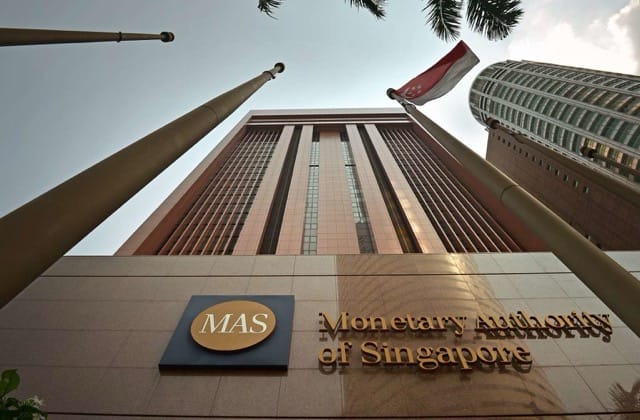
MAS Singapore. Source: VnEconomy
Under the Insurance Act, the MAS ensures that insurers maintain high solvency margins and adhere to strict codes of conduct regarding product disclosures.
For expats, this provides a layer of security: the policy you buy is backed by a stable legal framework, and the “benefit illustrations” provided are standardized to prevent misleading claims.
Furthermore, the Policy Owners’ Protection Scheme (PPW), administered by the Singapore Deposit Insurance Corporation (SDIC), provides a safety net for policyholders even in the rare event of an insurer’s insolvency.
Why Expats Should Consider Local Life Insurance Plans
While you might have a policy from your home country, local life insurance plans singapore offer specific advantages:
- Currency Matching: If your primary liabilities, such as a mortgage on a Singapore condo or international school fees, are in SGD, a local plan eliminates the risk of currency fluctuations devaluing your protection.
- Medical Underwriting: It is often easier to clear medical underwriting while you are actively working and residing in the country. If you wait until you move to a new region, age and new health conditions could make premiums prohibitive.
- Tax and Residency integration: Having a local insurance portfolio demonstrates financial stability to authorities if you eventually seek Permanent Residency (PR).
What Are The 4 Types Of Life Insurance Singapore?
Understanding the types of life insurance available is the first step toward building a solid financial plan.
1. Term Life Insurance Singapore
What It Is:
This is a pure protection plan. It provides coverage for a fixed duration (e.g., 5, 10, 20, 30 years or until a specific age like 65). It has no cash value; if the policy expires while you are still alive, no money is returned.
How It Works in Singapore:
Because it lacks a savings component, premiums are remarkably affordable. You can secure coverage of $1 million or more for a fraction of the cost of other plans.
These plans are often used by expats to cover the “high-risk” years, specifically until children graduate or a mortgage is paid off.

Term life insurance plans in Singapore. Source: Seedly Blog
Who Should Consider It:
- Expats staying for a fixed contract (3–10 years).
- Young families who need maximum protection on a tight budget.
- Individuals with large Singapore-based debts.
Pros & Cons:
- Pros: Most cost-effective way to get high coverage; highly flexible; easy to cancel if you leave.
- Cons: No return on premiums; costs increase significantly if you try to renew or purchase a new plan at an older age.
2. Whole Life Insurance Singapore
What It Is:
Provides permanent, lifelong coverage (typically up to age 99 or 100).
It includes a “participating” element, in which a portion of your premiums is invested in the insurer’s life fund, building both guaranteed and non-guaranteed cash value (bonuses) over time.
How It Works in Singapore:
Singaporean whole life plans are famous for “multiplier” benefits. For example, a policy might pay 4x the sum assured if death occurs before age 70, effectively functioning like a term policy during your working years and a legacy policy thereafter.
Many offer “limited-pay” options where you pay premiums for 10 or 20 years but remain covered for life.
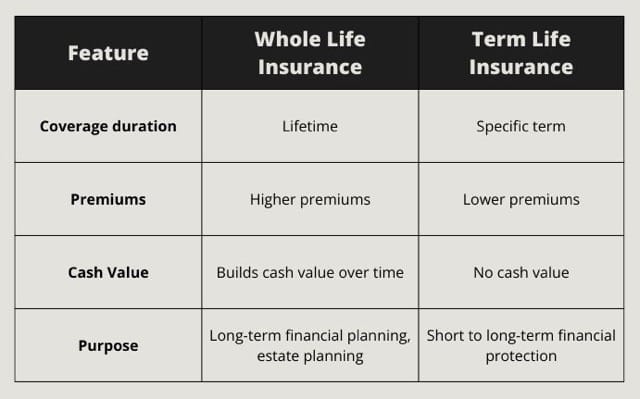
Whole life vs Term life insurance. Source: Singlife
Who Should Consider It:
- Long-term residents or those seeking PR/Citizenship.
- Parents wanting to leave a guaranteed inheritance for children.
- Individuals looking for a “forced savings” element that also covers medical crises.
Pros & Cons:
- Pros: Lifelong protection; builds a cash buffer you can borrow against; premiums remain level and never increase.
- Cons: Significantly higher premiums than term life; high surrender charges if you cancel in the first 10 years.
3. Investment-Linked Policies (ILPs) Singapore
What It Is:
A hybrid product that combines life insurance with investment. Your premiums buy units in various sub-funds (unit trusts) managed by the insurer.
How It Works in Singapore:
A portion of your units is sold each month to pay for insurance (COI), while the rest remains invested. The cash value is entirely dependent on market performance.
In Singapore, ILPs are popular because they offer the potential for higher returns and allow for “premium holidays” if you experience a temporary loss of income.
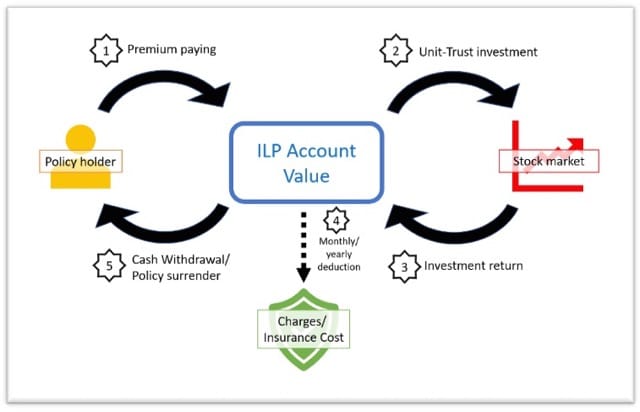
Investment-Linked Policies (ILPs) explained. Source: GEN Financial Advisory
Who Should Consider It:
- Expats comfortable with market volatility who want insurance and investment in one account.
- Individuals who want the flexibility to “top-up” or “switch” funds as market conditions change.
Pros & Cons:
- Pros: Potential for market-beating returns; flexibility to adjust coverage; usually offers “free switches” between funds.
- Cons: No guaranteed cash value; the cost of insurance rises as you age, which can deplete your investment units if the market is down.
4. Universal Life Insurance Types (IUL / VUL)
What It Is:
Sophisticated, high-value insurance plans designed for wealth preservation. Indexed Universal Life (IUL) is, linking cash value growth to market indices (like the S&P 500) while providing a “floor” (usually 0% or 1%) to protect against market losses.
How It Works in Singapore:
Commonly denominated in USD, these plans are a staple for high-net-worth (HNW) expats.
They are often used for “premium financing,” where a bank lends the policyholder the premium at a low interest rate, allowing the client to maintain liquidity while securing a massive death benefit for estate planning.
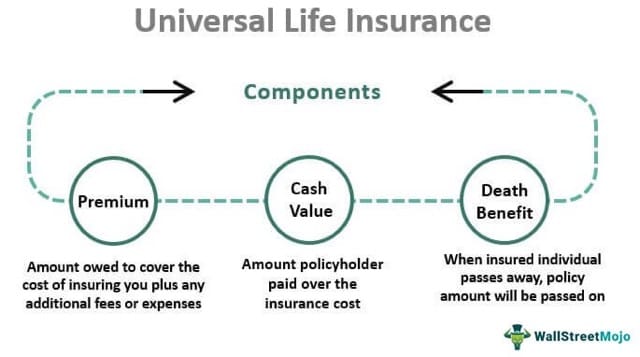
Universal Life Insurance plan explained. Source: WallStreetMojo
Who Should Consider It:
- High-net-worth expats with global estates exceeding $5 million.
- Individuals seeking tax-efficient wealth transfer and offshore asset protection.
Pros & Cons:
- Pros: Huge coverage amounts; high flexibility in premium payments; globally portable USD assets.
- Cons: Extremely complex; requires high initial capital; subject to “cap” rates on investment gains.
Term vs Whole Life Insurance Singapore: The Financial Reality
The choice between term vs whole life insurance Singapore usually boils down to your residency status and “buy term and invest the difference” philosophy.
| Feature | Term Life Insurance | Whole Life Insurance |
| Average Cost (Age 35) | ~$300 – $500 / year for $500k | ~$3,000 – $5,000 / year for $500k |
| Duration | Fixed (e.g., to age 65) | Lifelong (to age 99/100) |
| Cash Component | None | Builds guaranteed/non-guaranteed value |
| Portability | Very high (simple to maintain) | Moderate (long-term commitment) |
| Best For | Income replacement for young families | Legacy, PR-aspirants, and funeral costs |