Trust Fund Singapore For Expats: What To Keep In Mind
Post date:


Key Takeaways
- Trust funds in Singapore give expats stronger control and protection than Wills alone. Choosing the right structure, especially between revocable vs irrevocable trust options, directly affects asset protection, tax exposure, and how wealth is passed across generations, making upfront planning essential for expats
- Setting up a trust in Singapore requires careful structuring around property, tax, and cross-border rules. Key considerations include ABSD on property held in living trusts, FATCA and CRS reporting, beneficiary residency, and alignment with home-country inheritance or estate tax laws, all of which impact long-term outcomes.
- Blue Alpha Capital helps expats turn trust structures into long-term legacy strategies
- Beyond trust setup, we support Singapore expats with trustee selection, deed structuring, asset funding decisions, and ongoing alignment with estate and legacy goals under Singapore’s evolving trust framework.

What You Need To Know About Singapore Trust Funds
What Is a Trust Fund?
A trust fund is a legal arrangement used in estate and wealth planning to protect and manage assets for the benefit of chosen individuals or causes. In Singapore, a trust fund allows you to transfer assets into a structured framework that continues to operate according to your instructions, even if your personal circumstances change.

General explanation of trust fund. Source: Investopedia
At its core, a trust fund involves 3 key parties:
- Settlor – You, the person who places assets into the trust
- Trustee – A professional party (such as a private bank, trust company, or lawyer) who holds and manages the assets
- Beneficiaries – The individuals or organisations who benefit from the trust, such as family members or charities
Once assets are placed into the trust, the trustee manages them according to rules you set out in a trust deed. These rules define how assets are invested, when distributions are made, and under what conditions beneficiaries can access them.
Types of Trusts
A key decision when creating a trust is choosing between a revocable vs irrevocable trust. Revocable trusts offer flexibility and ongoing control, while irrevocable trusts provide stronger asset protection and estate preservation, often preferred for long-term legacy planning.
- Revocable Trust (Living Trust)
A revocable trust offers flexibility and control, making it suitable for asset management during your lifetime.
- Control: High – you retain full control and can amend or revoke the trust at any time
- Flexibility: High – assets, beneficiaries, and terms can be changed
- Asset protection: Low – assets are still treated as yours and remain exposed to creditors
- Tax benefits: Limited – assets remain part of your taxable estate
- Best used for: Probate avoidance, orderly asset management, and continuity if you become incapacitated
This type of trust is often chosen for convenience rather than protection.
- Irrevocable Trust
An irrevocable trust prioritises protection and long-term planning over flexibility.
- Control: Low – once assets are transferred, control is largely given up
- Flexibility: Low – changes usually require beneficiary consent or court approval
- Asset protection: High – assets are generally shielded from creditors and lawsuits
- Tax benefits: High – assets are removed from your estate, potentially reducing estate taxes
- Best used for: Estate tax planning, asset protection, and long-term legacy preservation
This structure is commonly used by expats focused on wealth preservation across generations.
Beyond revocable and irrevocable trusts, Singapore also supports several trust structures used for private and offshore planning:
- Discretionary trusts – Trustees decide how and when income or capital is distributed, offering high flexibility
- Fixed trusts – Beneficiaries have predetermined rights to income or capital
- Purpose trusts – Created for specific non-charitable purposes, requiring careful structuring
- Charitable trusts – Established for philanthropic goals and regulated under Singapore law
How a Trust Fund Works in Singapore
When setting up a trust in Singapore, ownership is separated: the trustee holds legal ownership, while beneficiaries hold the beneficial interest. This allows assets to be professionally managed without being directly controlled by beneficiaries.
Trusts in Singapore are governed by the Trustees Act and regulated trust companies are overseen by the Monetary Authority of Singapore (MAS), giving expats a stable and well-regulated framework for long-term planning.
Trust funds are commonly used for:
- Asset protection, as trust assets are generally shielded from personal creditors
- Financial management for minors or vulnerable dependants
- Estate planning, as trust assets bypass probate for smoother distribution
- Tax efficiency, when structured appropriately
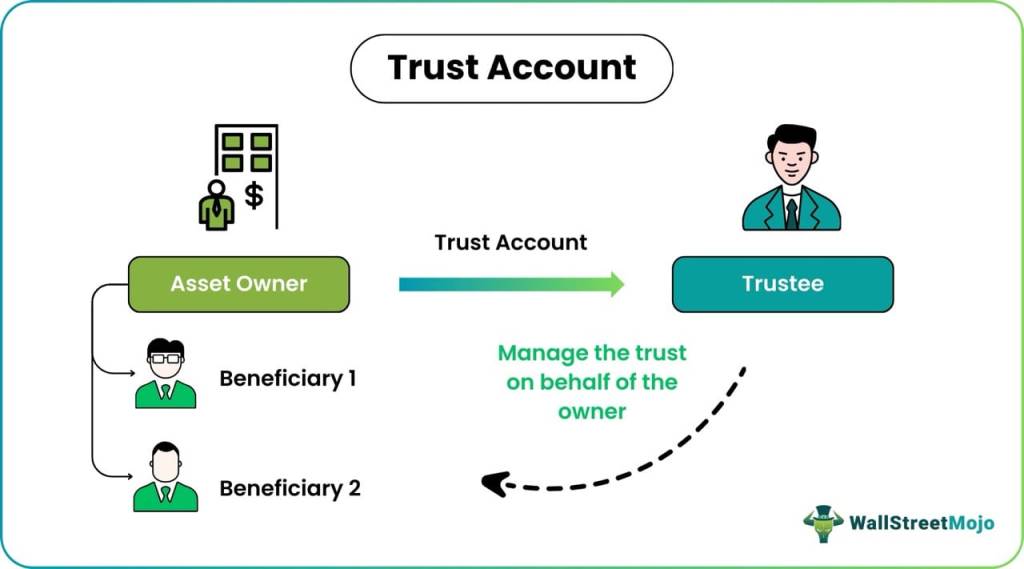
How trust fund works generally. Source: WallStreetMojo
Singapore Trust Law: Latest Updates (Locals & Expats)
A trust fund Singapore structure is primarily governed by two key statutes: the Trustees Act, which sets out the duties and powers of trustees, and the Trust Companies Act, which regulates licensed trust companies under the oversight of the Monetary Authority of Singapore (MAS).
Under current rules, trusts created on or after 15 December 2004 can last up to 100 years, offering long-term planning flexibility. Singapore law also provides strong asset protection, including a 5-year claw-back period for insolvency.
One of the most significant developments in Singapore: affects property held in trusts: Additional Buyer’s Stamp Duty (ABSD – Trust) applies to residential property transferred into a living trust from 9 May 2022, charged at a flat 65% of the property value.

How ABSD works. Source: PropertyGuru
- ABSD remission may be available if all beneficiaries are identified at transfer, are Singapore citizens, and meet property ownership conditions
- Testamentary trusts created through a Will and effective only after death are exempt from ABSD (Trust)
- Singapore trust companies must comply with FATCA and CRS reporting, increasing transparency for expats with overseas tax exposure
- The Inland Revenue Authority of Singapore (IRAS) has enhanced enforcement powers to support domestic and international tax compliance
ABSD payment process in Singapore. Source: PropertyGuru
Singapore has also strengthened international tax compliance:
- Trust companies must comply with FATCA (for US persons) and CRS (for global tax reporting)
- The Inland Revenue Authority of Singapore (IRAS) has expanded powers to enforce tax transparency and reporting
These measures affect expats more directly, especially those with overseas tax obligations.
Can Expats Set Up Trust Fund In Singapore?
Yes. Expats can legally set up a trust fund in Singapore, and many do so for asset protection, estate planning, and cross-border wealth management. However, the structure must be carefully designed to account for property rules, international tax reporting, and home-country inheritance or estate tax laws.
Note: Singapore trusts can override forced heirship rules from other countries, as long as Singapore law governs the trust and the trustees are based in Singapore.
Practical Differences for Locals and Expats
| Aspect | Locals (Singapore Citizens / PRs) | Expats |
| Testamentary freedom | Full freedom under Singapore law to distribute assets via Wills and trusts | Can set up Singapore trusts, but must consider interaction with home-country inheritance laws |
| Trust income tax | Trust income is taxed at the beneficiary level if beneficiaries are Singapore tax residents | Trust income may not be taxed in Singapore if there are no Singapore resident beneficiaries and no Singapore-based assets; overseas tax exposure still applies |
| Property ownership via trust | Residential property held in a living trust may be subject to ABSD (Trust), with remission possible if criteria are met | Stricter ABSD (Trust) exposure; non-citizens may also require approval to own certain residential property types |
| Stamp duty considerations | ABSD remission more achievable when beneficiaries are Singapore citizens | ABSD rules are more restrictive when expats use living trusts for residential property |
| Cross-border complexity | Generally limited to Singapore legal and tax framework | Requires careful coordination with home-country tax, estate, and reporting obligations |
Setting Up A Trust In Singapore (For Expats)
Step 1: Define Objectives And Lock In The Trust Structure
Setting up a trust in Singapore starts with deciding exactly what the trust must achieve, not broadly but functionally. This determines whether the trust is revocable or irrevocable, discretionary or fixed, and whether it should operate during your lifetime or only after death.
At this stage, expats should make specific decisions on:
- Whether the priority is asset protection, succession control, or tax and estate planning
- Whether assets must remain accessible during life (revocable) or fully ring-fenced (irrevocable)
- Whether beneficiaries need flexibility over time (discretionary trust) or fixed entitlements
- Whether the trust should operate now (living trust) or later via a Will (testamentary trust)
These are structural decisions, not legal formalities.
Changing them later often requires redrafting or asset re-transfer. This is where Blue Alpha Capital works with expats to align trust structure with estate goals, family profiles, and cross-border exposure, before legal documents are drafted. Schedule an appointment with our consultant today!
Step 2: Appoint The Trustee And Define Decision Authority
The trustee controls how the trust operates day to day. In Singapore, trustees must be Singapore-resident individuals or MAS-regulated trust companies. For expats, professional trustees are typically chosen for continuity, regulatory compliance, and neutrality.
Key decisions at this stage include:
- Whether to appoint a professional trust company or an individual trustee
- Whether trustees act alone or alongside protectors or co-trustees
- How much discretion trustees have over investments and distributions
- How trustees are replaced if performance or circumstances change
This is not about “trusting someone personally”, it is about governance and enforceability.
A poorly defined trustee role leads to stalled distributions, family disputes, or regulatory issues. Blue Alpha Capital coordinates trustee selection and governance terms to ensure trustees can act decisively while staying aligned with the settlor’s intent.
Step 3: Identify Beneficiaries, Assets, And Funding Scope
This step defines who benefits and what is committed, and directly affects compliance, tax treatment, and long-term sustainability.
Beneficiary decisions must be precise:
- Named individuals, classes of beneficiaries, or charities
- Current vs future beneficiaries (e.g. children, grandchildren)
- Conditions tied to age, milestones, or needs
Asset decisions must be deliberate:
- Cash, investment portfolios, business shares, or real estate
- Singapore vs overseas assets
- Whether assets are transferred immediately or staged over time
This is also where funding-related costs surface:
- Valuation costs for businesses or investments
- Stamp duties and transfer costs (especially for property)
- Initial structuring costs tied to asset complexity
Overfunding or misaligned assets create inefficiencies. Underfunding weakens the trust’s purpose. Planning at this stage avoids both.
Step 4: Draft The Trust Deed With Enforceable Terms
The trust deed must translate intent into clear, enforceable instructions under Singapore law.
In fact, it is used to specify:
- Distribution rules (timing, conditions, discretion)
- Investment authority and limits
- Treatment of income vs capital
- Powers to amend, terminate, or restructure
- Contingencies for incapacity, death, or regulatory change
Poor drafting leads to trustee paralysis or unintended outcomes. Overly rigid drafting removes flexibility. This balance is where experience matters.
Blue Alpha Capital works alongside legal counsel to ensure the deed reflects real-world scenarios, family changes, regulatory updates, and cross-border implications, without constant legal intervention. See how we do it for you!
Frequently Asked Questions
- Is a trust fund a good ideas?
Yes, a trust fund is a good idea if you want stronger asset protection, controlled wealth distribution, and long-term estate planning, especially for families, minors, or cross-border assets.
- How much money do I need to put in a trust fund?
There is no fixed minimum, but trusts are generally cost-effective from SGD 100,000+, depending on complexity, assets involved, and ongoing trustee fees.
- What are the 4 types of trusts?
The four common types are revocable trusts, irrevocable trusts, discretionary trusts, and fixed trusts.
- What is the disadvantage of a family trust?
The main disadvantages are loss of control (for irrevocable trusts), ongoing trustee and administration costs, and limited flexibility once the trust is established.