
LPA Singapore: Definition, Purpose, & How It Works For Expats
Post date:

Key Takeaways
- LPA Singapore protects you while you are alive, not after death. It ensures trusted people can make urgent personal welfare and financial decisions on your behalf if you lose mental capacity, something a Will does not cover.
- For expats, an LPA Singapore is critical because family members are often overseas and not automatically authorised to act. Without an LPA, loved ones may face court delays, legal costs, and stress just to manage care or access funds.
- Applying for an LPA Singapore is straightforward and affordable, with most applicants using LPA Form 1 through the official OPG portal. Setting it up early avoids unnecessary legal complications and provides clarity for both you and your family.
What Is LPA Singapore?
An LPA Singapore (Lasting Power of Attorney) is a legal document that allows a person to plan ahead for a possible loss of mental capacity. It lets you appoint one or more trusted individuals to make decisions and act on your behalf if you are no longer able to do so in the future.
In the lasting power of attorney Singapore framework, the person creating the LPA is called the Donor. The Donor must be at least 21 years old and have mental capacity at the time the LPA is made. The appointed individuals are known as Donee(s). They can only act if the Donor later loses mental capacity.
When explaining what is an LPA, it helps to know that Donee(s) may be appointed to act in one or both of the following areas:
- Personal Welfare – decisions about medical care, living arrangements, and daily care.
- Property & Affairs – managing bank accounts, CPF matters, property, investments, and signing legal documents or deeds on the Donor’s behalf.

LPA working process. Source: MSF
An LPA is a legally binding deed. It ensures that, if mental capacity is lost, decisions are made by people you trust, according to the authority you have clearly set out in advance.
LPA Singapore vs Will: Which One Should You Choose?
Both an LPA and a Will are essential planning tools in Singapore, but they serve very different purposes at different stages of life.
| Aspect | Lasting Power of Attorney (LPA) Singapore | Will |
| When it takes effect | When you lose mental capacity during your lifetime | After your death |
| What it covers | Personal welfare and/or property & affairs decisions | Distribution of assets and estate matters |
| Who is appointed | Donee(s) to act on your behalf | Executor(s) to carry out your wishes |
| Key decisions | Medical care, living arrangements, bank accounts, CPF, property, investments | Who receives your assets, guardians for minor children |
| Legal status | A legal deed that activates upon incapacity | A legal document that activates upon death |
| Relevance for expats | Ensures trusted people can manage your affairs in Singapore if you become incapacitated | Ensures your Singapore and overseas assets are distributed according to your wishes |
| Relationship to each other | Covers incapacity while you are alive | Covers estate matters after death |
For expats living in Singapore,
Choose an LPA if…
- You are an expat living in Singapore and want a clear plan in place if illness or an accident leaves you unable to make decisions.
- You need a trusted person in Singapore to handle medical decisions, daily care, bank accounts, CPF matters, or property while you are still alive.
- You want to avoid delays, uncertainty, or court-appointed deputies, especially important when family members live overseas.
Choose a Will if…
- You want to control how your Singapore and overseas assets are distributed after death.
- You need to appoint executors or guardians, particularly if your children or beneficiaries are based in different countries.
- You want to reduce cross-border disputes and ensure your estate is handled clearly under your wishes.
In practice, an LPA and a Will are not alternatives, especially for expats.
An LPA protects you during your lifetime if mental capacity is lost, while a Will governs your estate after death. Having both in place ensures continuity, clarity, and control across jurisdictions, covering every stage where decisions matter most while living in Singapore.
Why Should You Have a Lasting Power of Attorney Singapore?
For most people, an LPA only feels relevant when something goes wrong. That’s usually too late.
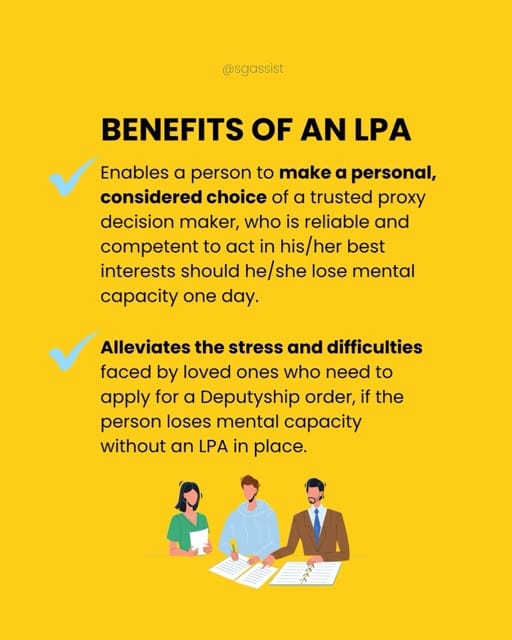
Loss of mental capacity can happen suddenly, through an accident, a stroke, or illnes, or gradually, through conditions like dementia. Without an LPA Singapore in place, your family is not automatically allowed to make legal or financial decisions for you, even if they are your spouse or children.
This is where the real risk lies.
If you lose mental capacity without an LPA, your loved ones may need to apply to the Singapore courts to be appointed as your deputy just to:
- Access your bank savings for medical or caregiving expenses
- Make decisions about your care or living arrangements
- Handle urgent financial or property matters
That process takes time, legal fees, and emotional energy, often at the worst possible moment.
Benefits of LPA. Source: SG Assist
For expats, this risk is even higher. Family members are often based overseas, unfamiliar with Singapore’s legal system, or unable to act quickly when something happens.
Blue Alpha Capital supports this by helping you put the right structures in place early, starting with a Lasting Power of Attorney Singapore.
Our partnering process is practical:
- Put a Lasting Power of Attorney in place so trusted people can act quickly if mental capacity is lost
- Align your LPA, Will, and wider estate structure so there are no legal gaps
- Ensure decisions reflect your values, not just asset distribution, especially when family dynamics are complex
We position it as part of a broader legacy and estate blueprint. This means planning not only for emergencies, but also for how your wealth, responsibilities, and intentions are carried forward. Talk to our specialist today!
How To Apply For LPA Singapore
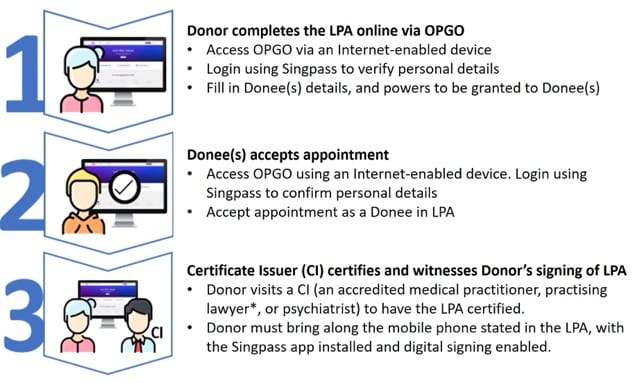
Applying for an LPA Singapore is a structured but straightforward process. For most people, including expats with SingPass access, the entire application can be completed online using LPA Form 1, the most commonly used option in Singapore.
Below is a clear, practical guide on how to apply for a lasting power of attorney Singapore, explain based on the official Office of the Public Guardian (OPG) process.
Step 1: Complete the LPA Application Online (OPG Portal)
Start by accessing the Office of the Public Guardian Online (OPGO) portal:
https://opg-eservice.msf.gov.sg/
Log in with your SingPass and follow the step-by-step guided process. The system is designed to be user-friendly and allows you to save and return if needed.
Before you begin, prepare the following key decisions and details.
a) Decide on Your Donee(s)
Your Donee(s) are the people you appoint to make decisions on your behalf if you lose mental capacity.
You may choose:
- One Donee, or
- More than one Donee
If you appoint multiple Donees, you must specify how decisions are made:
- Jointly – all Donees must agree before any decision is made
- Jointly and severally – Donees may decide together or individually
You may also appoint Replacement Donee(s). These individuals step in if your original Donee is unable or unwilling to act in the future.
How to make a LPA in Singapore. Source: MSF
This decision is critical, especially for expats, as your Donee may need to act quickly in Singapore while family members are overseas.
b) Prepare Personal Details of Your Donee(s)
You will need the following information for each Donee:
- Full name
- NRIC (or relevant identification)
- Email address
Ensure these details are accurate, as they are used for official notifications and acceptance.
c) Answer the Power-Related Questions
During the application, you will be asked 3 structured questions that determine the scope of powers you grant to your Donee(s). These relate to:
- Personal welfare decisions
- Property and financial affairs
The Ministry of Social and Family Development (MSF) has published a detailed walkthrough video explaining this process, which can be accessed through the OPG portal if you need guidance.
Step 2: Donee(s) Accept Their Appointment Online
Once you submit your application, your Donee(s) will receive a notification via Singpass.
Each Donee must:
- Log in to the OPG portal
- Review their appointment
- Formally accept the role
The application cannot proceed unless all appointed Donee(s) have accepted.
Step 3: Visit a Certificate Issuer (In Person)
After your Donee(s) have accepted, you must be certified by a Certificate Issuer (CI). This step confirms that:
- You understand what an LPA is
- You are making the LPA voluntarily
- You have mental capacity at the time of application
A Certificate Issuer can be:
- An accredited medical practitioner
- A practising lawyer
- A registered psychiatrist
You can find an approved CI near you using the official OPG directory:
https://opg-eservice.msf.gov.sg/LPA/CIMapService.aspx
Some notes you need to be aware of:
- Fees typically range from $50 to $200, depending on the clinic
- Most clinics require an appointment
- Some clinics may require both Donor and Donee(s) to attend, while others only require the Donor
Once certified, the CI submits the LPA directly to OPG through the system. You will receive confirmation via SMS or email when your digital LPA is successfully registered.
Frequently Asked Questions
- Is LPA still free in Singapore?
Permanent residents and foreigners pay standard fees.
- Is LPA the same as a will?
No. An LPA Singapore applies during your lifetime if you lose mental capacity, while a Will takes effect after death to distribute assets.
- Do I need a lawyer to do LPA?
No. LPA Form 1 does not require a lawyer and can be completed online via the OPG portal. A lawyer is only needed for LPA Form 2 (customised powers).
- How much does a LPA cost in Singapore?
For Singapore citizens, Form 1 currently costs $0 (fee waived). Permanent residents pay from $90, and foreigners from $230, excluding certification fees.