Will and Trust: Understanding the Key Differences in Estate Planning
Post date:


Key Takeaways
- Wills and trusts serve different purposes in estate planning, with a will directing the distribution of assets after death and a trust managing assets during life and after death, providing added control and privacy.
- A valid will in Singapore requires strict legal conditions, including being of a sound mind, proper execution, and the presence of qualified witnesses, to ensure that asset distribution and guardianship instructions are enforceable.
- Trusts offer flexibility and protection not available in a will, including bypassing probate, facilitating long-term management for beneficiaries, and providing incapacity planning through a successor trustee.
- Most expats benefit from using both a will and a trust, as a will covers guardianship and assets that are not transferred. In contrast, a trust ensures privacy, faster distribution, and smoother cross-border estate management.
What Is a Will in Estate Planning?
A will, formally known as your last will and testament, is a legal document that outlines how your assets (property, money, investments, heirlooms, and any item of financial value) should be distributed after your death.
It is a core component in wills and trusts planning and serves as the foundation when comparing a will trust or assessing living trust vs will options within a broader estate strategy.
A will ensures your wishes are followed, reduces potential family disputes, and provides a clear, legally recognised plan for your heirs.

Your will is also where you:
- Define how you would like your estate to be divided, including real estate, cash, savings, and personal belongings.
- Name your executor, who will manage your estate, settle outstanding obligations, and carry out your instructions.
- Designate beneficiaries who will inherit specific assets.
- Appoint guardians for minor children or pets so their care is clearly planned.
- Allocate any charitable gifts to organisations or causes you support.
- Express your funeral or burial wishes, if you prefer them included in your estate plan.
Requirements of a Will in Singapore
For a will to be legally valid in Singapore, it must meet specific formal requirements under the Wills Act.
These rules ensure that the document accurately reflects the testator’s true intentions and can withstand legal scrutiny, an essential foundation in wills and trusts planning.
- In writing: The will must be documented in written form. It may be handwritten or typed, but it must exist as a physical written document.
- Minimum age requirement: The testator must be at least 21 years old (An exception applies to privileged wills made by individuals in active military service, at sea, or serving as seamen.)
- Sound mind and free will: The testator must be of sound mind, fully understanding the nature and consequences of the will. The document must be made voluntarily, without pressure, coercion, or undue influence from others.
- Proper signature of the testator: The testator must sign the will at the bottom or end of the document. Any additional writing placed below the signature is not considered part of the will and will be invalid.
- Witness requirements:
- The will must be signed in the presence of 2 witnesses, and both witnesses must be present at the same time when the testator signs.
- These witnesses must also sign the will in the presence of the testator.
- Importantly, beneficiaries, or the spouses of beneficiaries, cannot serve as witnesses, as this would invalidate their entitlement under the will.
These requirements ensure that the will is legally enforceable, clearly executed, and protected against disputes or claims of improper influence.
What Is a Trust in Estate Planning?
A trust is a legal arrangement that allows you to transfer ownership of your assets—such as investments, cash, real estate, or life insurance proceeds, to a trustee, who manages those assets for the benefit of your chosen beneficiaries.
This structure is commonly used in wills and trusts planning and helps you control how and when your wealth is distributed, both during your lifetime and after your death.
A trustee may be an individual or a licensed trust company, depending on the level of expertise, oversight, and administrative support you need.
A trust can serve different estate planning goals, such as protecting assets, ensuring long-term financial support for dependants, avoiding probate, or managing complex cross-border situations that expats often face.
This is also where many people compare a will trust or evaluate living trust vs will to understand which structure suits their needs best.

Types of Trusts
- Testamentary trust:
Created under your will and only takes effect after your death.
- Living trust (inter vivos trust):
Created during your lifetime and may be either revocable or irrevocable.
- Revocable living trust
You transfer assets into the trust but retain control over them. You can amend, replace, or dissolve the trust at any time, depending on the terms. However, because the assets are still considered yours, they remain taxable in your name and are not shielded from creditors.
- Irrevocable living trust
Once established, this trust generally cannot be changed unless the beneficiaries consent. Since assets are no longer owned by you but by the trust itself, they may reduce estate taxes (probate fees) and offer enhanced protection from creditors.
Although setting up a trust can be more complex and may involve administrative costs, a well-structured trust can streamline estate distribution, especially when created during your lifetime, as it can bypass probate and simplify the management of your estate.
Requirements of a Trust in Singapore
To establish a valid trust in Singapore, the arrangement must meet specific legal requirements that ensure the trust is clearly defined, properly documented, and enforceable.
- Certainty of intention: The settlor must clearly demonstrate the intention to create a trust. This intention is documented in the trust instrument, ensuring there is no ambiguity about the purpose or structure of the trust.
- Certainty of subject-matter: The assets being placed into the trust must be clearly identified. These assets can include cash, real estate, investments, or other forms of property.
- Certainty of objects: The beneficiaries must be identifiable.
- For a fixed trust, there must be a complete list of beneficiaries.
- For a discretionary trust, it must be possible to determine with certainty who is (or is not) part of the beneficiary class.
- Trust instrument: A formal written document, typically a trust deed, must be drafted and signed by the settlor. This instrument outlines the terms, powers, and duties governing the trust.
- Trustee appointment: At least one trustee must be appointed to hold and manage the trust assets on behalf of the beneficiaries. The trustee can be an individual or a licensed trust company.
- Asset transfer: A trust is only fully established once legal ownership of the assets has been transferred to the trustee. This may involve updating property titles, re-registering investment accounts, or opening new accounts in the trustee’s name.
Other notices in Singapore trust system:
- Singapore does not require general registration of trusts with ACRA.
- Trust companies must be licensed by MAS and meet regulatory requirements, including a minimum paid-up capital of S$250,000.
- Trustees have ongoing obligations, including maintaining records for a minimum of five years and keeping beneficiary information up to date.
- Trusts established after 15 December 2004 can have a maximum duration of 100 years, unless otherwise specified in the trust deed.
These requirements ensure that a trust is structured correctly, legally recognisable, and capable of protecting and managing assets according to the settlor’s long-term intentions.
The Differences Between a Will and a Trust
Understanding living trust vs will helps you decide which structure fits your estate, your family needs, and your long-term financial planning goals in Singapore.
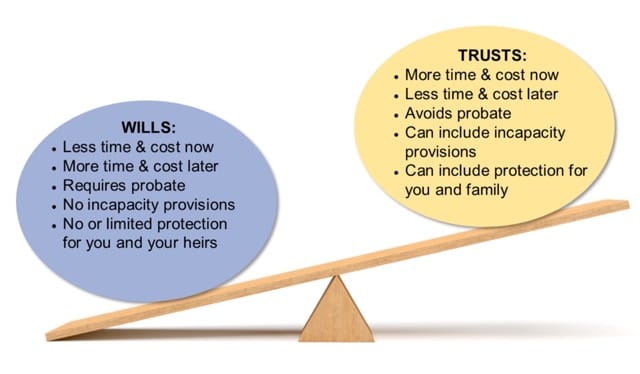
Here is a clear comparison combining all the information provided.
Effective date
- Will: Only takes effect after death. Your instructions cannot be acted on while you’re alive.
- Trust: Takes effect once it is created and funded. It can operate during your lifetime and continue after your death.
Probate and distribution
- Will: Must go through probate, a public court process that verifies the will and authorises asset distribution. In Singapore, probate can be straightforward for simple estates but may take longer for complex or cross-border assets.
- Trust: Assets held by the trust are exempt from probate, enabling faster and more private distribution. This is particularly useful for expats with multi-jurisdictional holdings, where probate delays are more common.
Guardianship
- Will: Essential for naming legal guardians for minor children or dependents. This is a function that only a will can perform.
- Trust: Cannot appoint guardians. A trust only manages assets, not childcare arrangements.
Incapacity planning
- Will: Does not take effect during your lifetime and cannot help if you become mentally or physically incapacitated.
- Trust: A successor trustee can step in to manage your assets immediately if you become incapacitated. This ensures continuity and protection of your finances without court involvement.
Privacy
- Will: Becomes a public record during probate. Anyone can access basic details of your estate.
- Trust: Remains a private document. No probate means no public disclosure of your assets or beneficiaries.
Complexity and cost
- Will: Generally simpler, faster, and more affordable to set up. Suitable for straightforward estates or families primarily focused on asset distribution and guardianship.
- Trust: More complex and costly to establish due to drafting requirements and trustee administration. However, a trust offers greater control, such as:
- Staggered or conditional inheritance
- Asset protection in certain structures
- Management for vulnerable or young beneficiaries
- Smoother cross-border administration for expats
Purpose and function
- Will: Directs distribution of your estate after death, names guardians, and finalises instructions. It does not manage assets during life.
- Trust: Manages and protects assets during life and after death, supports beneficiaries over time, and provides incapacity protection. It cannot replace a will entirely because it cannot name guardians.
Do You Need Both a Will and a Trust?
In most cases, yes, you need both a will and a trust, because each document serves a different purpose in your estate plan and they cannot fully replace one another.
Even if you set up a living trust, you still need a Will, specifically a Pour-over Will. This back-up document ensures that any asset not properly transferred into the trust during your lifetime will automatically “pour over” into the trust upon your death. Without it, any omitted assets would have no clear legal instructions.
A will is also essential for naming guardians for minor children, something a trust cannot do. In contrast, a trust manages your assets, supports beneficiaries over time, and provides protection if you become incapacitated.
If your estate is small and your goals are simple, a will alone may be sufficient. However, if you have a larger estate, more complex inheritance instructions, cross-border assets, or a need for creditor protection, a trust provides valuable control and flexibility.
For many individuals in Singapore, especially expats with multi-jurisdictional assets, the most complete strategy is to use both:
- A will to cover guardianship and any assets outside the trust
- A trust to manage assets during life and after death, while avoiding probate
Given the legal and financial complexities, it’s best to consult your wealth manager and an estate planning lawyer to structure both documents according to your personal goals and long-term financial plan.
BlueAlpha Capital – Practical Help for Expats Navigating Estate Planning in Singapore
As an expat, estate planning gets complicated fast, assets in different countries, guardianship concerns, probate rules you’re not familiar with, and questions about whether you really need a will, a trust, or both. BlueAlpha helps you make sense of all of this in a way that’s practical, clear, and tailored to your situation.
If your assets sit in the UK, US, Australia, or your home country while you live in Singapore, we help you understand:
- Whether one will is enough
- Whether you need separate wills for different countries
- How a trust can simplify your estate and avoid multi-country probate
You get clarity and a structure that actually works internationally.
We help you use a trust to solve real problems:
- Faster access for your family if something happens
- Privacy (no public probate record)
- Clear rules on who receives what and when
- Someone you trust managing things if you’re incapacitated
Everything is set up based on how you want your beneficiaries supported.
With BlueAlpha, your estate plan becomes clear, practical, and fully aligned with the realities of expat life. Consult with our estate planner now!