Writing A Will Singapore: Detailed Instructions For Expats
Post date:


Key Takeaways
- A properly drafted Last Will and Testament ensures your assets are distributed according to your wishes, guardians are appointed for minor children, and executors are clearly named, avoiding intestacy laws that may not suit expats with overseas assets or international families.
- A Will must meet strict Singapore legal requirements, including proper signing and witnessing, while also accounting for CPF exclusions, overseas assets, and differing inheritance laws.
- Blue Alpha Capital helps expats turn Wills into complete legacy plans. Beyond writing a Will, Blue Alpha Capital supports expats with structured estate and legacy planning, covering executorship, guardianship, trusts, insurance, and long-term wealth preservation across generations, all under one integrated approach.
What Is a Will in Estate Planning?
A Will, formally known as a Last Will and Testament, is a legal document that sets out how your assets should be handled after you pass away. In simple terms, it is your written instruction on who receives what, who manages your estate, and who takes care of your dependants.
In estate planning, a Will plays a central role because it gives you control. Without one, your assets in Singapore may be distributed according to intestacy laws, which follow fixed rules and may not reflect your personal wishes, especially for expats with international families, overseas assets, or blended households.
A Will is designed to be practical and clear. Its key functions include:
- Distribution of Assets: Your Will specifies how your assets, such as property, savings, investments, personal belongings, and valuables, are divided among beneficiaries. This ensures your wealth goes to the people or causes you choose.
- Appointment of an Executor: You name an executor, the person or professional responsible for administering your estate. This includes paying outstanding liabilities, handling paperwork, and distributing assets according to your instructions.
- Guardianship for Minor Children: If you have children under 21, a Will allows you to appoint legal guardians. This is one of the most important aspects for parents, as it ensures your children are cared for by someone you trust.
- Gifts and Charitable Donations: A Will lets you leave specific gifts, such as cash sums, personal items, or donations, to individuals or charitable organisations.
- Funeral and Burial Preferences: While not legally binding in all cases, a Will can outline your preferences for burial or cremation, helping guide your family during arrangements.
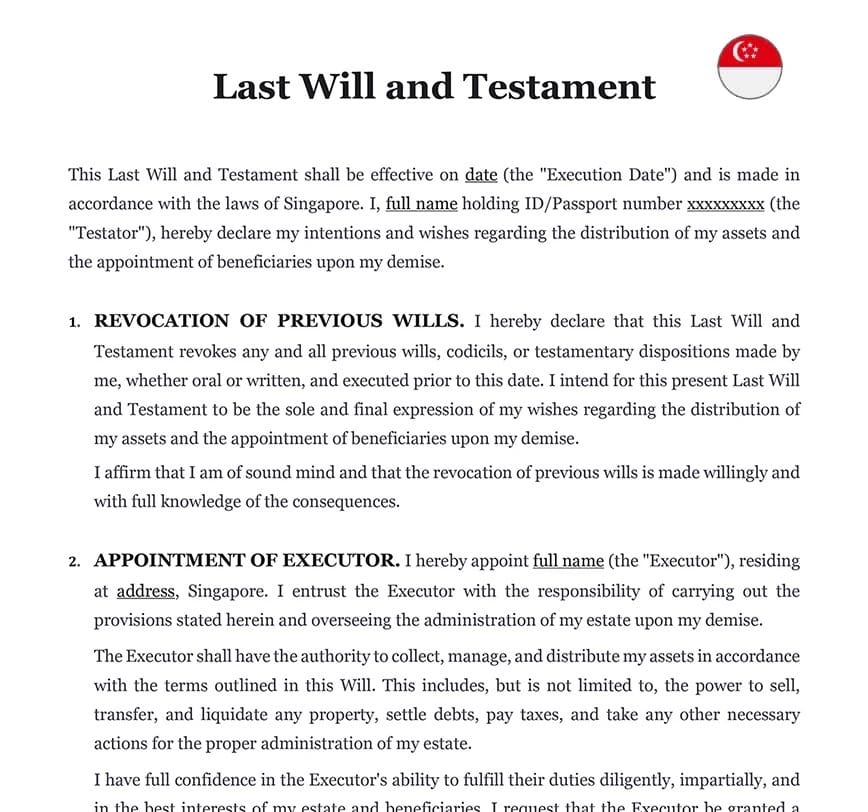
Will & Testament in Singapore. Source: Themis Partner Singapore
Requirements of a Will in Singapore
When writing a Will in Singapore, certain legal requirements must be met for the document to be valid and enforceable. This applies equally to locals and expats, making it especially important for anyone preparing an expat Will in Singapore to understand the rules clearly.
Below is a practical breakdown of what makes a Last Will and Testament in Singapore legally valid, followed by what you should include and key points expats should be aware of.
- Must be 21 years old or above
- Must be of sound mind (able to understand your assets, beneficiaries, and the effect of the Will)
- The Will must be made voluntarily, without pressure or coercion
- The Will must be in writing (typed or handwritten; digital-only Wills are not valid)
- You must sign at the end of the Will. If you are unable to sign, another person may sign in your presence and under your direction
- At least 2 witnesses must be present at the same time to see you sign and both witnesses must sign the Will in your presence
- Witnesses cannot be beneficiaries, and their spouses cannot be beneficiaries either, or the gift may be void
When preparing an expat Will in Singapore, keep these points in mind:
- Muslim Wills: Governed by different inheritance laws (Syariah law). Specialist legal advice is required.
- CPF Savings: CPF monies are not covered by a Will. A separate CPF Nomination must be made.
- Cross-border Assets: If you hold assets in multiple countries, professional advice helps ensure consistency across jurisdictions.
- Legal Advice: Strongly recommended for complex estates, blended families, or overseas dependants.
- Wills Registry: You may (optionally) register your Will with the Singapore Academy of Law (SAL) Wills Registry, which records the existence of your Will—not its contents.
Instructions for Writing a Will in Singapore
Prepare the Foundation: Personal Details, Assets, and Beneficiaries
The first and most important step in writing a Last Will and Testament in Singapore is gathering and clearly documenting the core information that defines your estate. This forms the legal and practical backbone of your Will. For expats, accuracy here is critical, as assets and family members are often spread across countries.
You should clearly state your personal details and identify everyone involved in the Will, leaving no room for ambiguity. At the same time, you must build a complete picture of what you own and owe, both locally and overseas.
Key items to prepare include:
- Your full name and identification details
- Full details of beneficiaries (names, relationships, locations)
- A clear list of assets and liabilities, including:
- Singapore property, savings, and investments
- Overseas property, offshore accounts, shares, or business interests
- Personal belongings and valuables
- An understanding that CPF monies are NOT covered under a Will and require a separate CPF Nomination
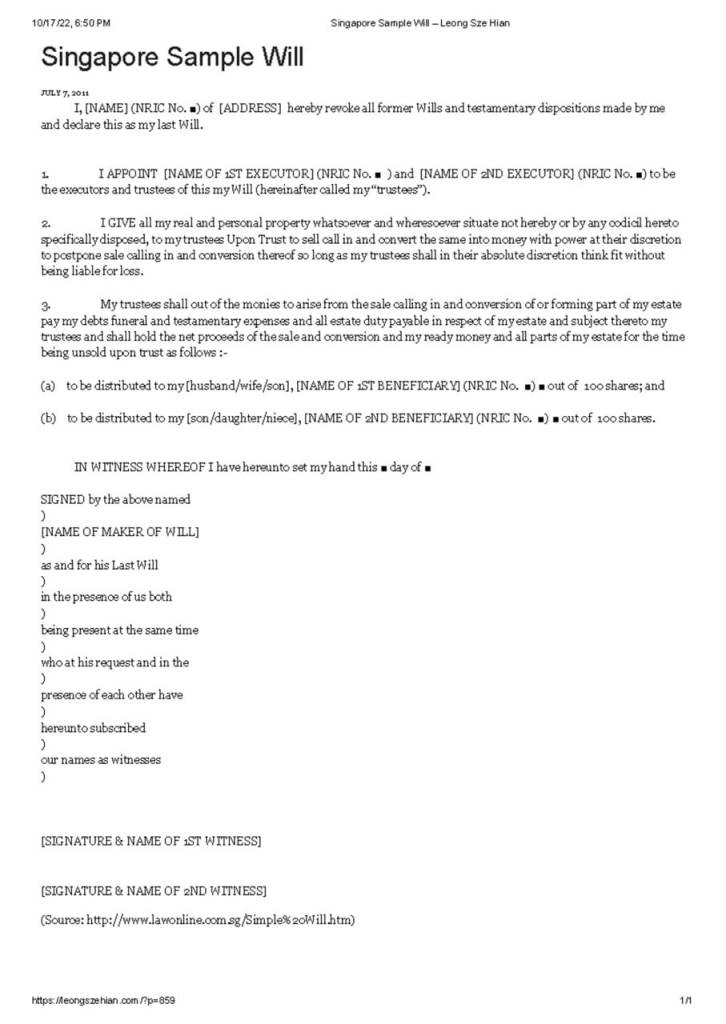
The will template in Singapore. Source: Scribd
This preparation ensures your expat Will in Singapore reflects your real financial position and reduces the risk of disputes or assets being unintentionally excluded.
Decide How Your Estate Is Managed and Distributed
Once your estate is clearly identified, the next step is deciding who manages it and how it is distributed. This is where your Will moves from information to instruction. Clear decision-making here prevents delays, family conflict, and unnecessary legal costs.
You will need to appoint one or more executors who are responsible for carrying out your wishes and administering the estate. You should also give precise instructions on how assets are divided, including what happens to anything not specifically mentioned.
Your Will should include:
- Appointment of one or more executors (must be 21 or older)
- Clear instructions on how assets are distributed (percentages, fixed sums, or specific assets)
- A residuary clause to cover any remaining assets not listed
- Consideration of charitable gifts or specific personal items
For expats, executor choice is particularly important. A professional executor or Singapore-based executor may help manage cross-border administration more efficiently.
Protect Dependants and Address Cross-Border Considerations
For many expats, estate planning is not just about assets—it is about protecting people. If you have minor children or dependants, your Will plays a crucial role in ensuring continuity of care and financial security.
You should also address cross-border estate issues early, as different countries may have conflicting inheritance rules.
This step typically includes:
- Appointment of guardians for minor children, if applicable
- Clear identification of guardians and backup guardians
- Consideration of where children will live and be raised
- Alignment of your Singapore Will with overseas Wills or foreign inheritance laws
- Awareness that Muslim Wills follow different legal frameworks
Failing to address these points may result in court-appointed guardians or unintended outcomes, particularly when families live outside Singapore.
Execute, Validate, and Store the Will Properly
Even a well-written Will is ineffective if it is not executed correctly. Singapore law has strict requirements, and mistakes at this stage can invalidate the entire document.
To ensure validity:
- The Will must be in writing (typed or handwritten)
- You must sign at the end of the Will
- Two witnesses must be present at the same time
- Witnesses must sign in your presence
- Witnesses (and their spouses) must not be beneficiaries
Once signed, secure storage is equally important:
- Keep the original Will in a safe, known location
- Inform your executor where it is stored
- Optionally register the Will’s existence with the Singapore Academy of Law (SAL) Wills Registry
Proper execution and storage ensure your writing a Will Singapore process results in a document that can be located, recognised, and acted upon when needed.
BlueAlpha Capital – Your Partner In Estate & Legacy Planning
Blue Alpha Capital is a Singapore-based financial planning firm specialising in estate and legacy planning for expats. We work with individuals and families who want clarity, structure, and long-term confidence in how their wealth is protected and passed on, both in Singapore and across borders.
How Blue Alpha Capital supports your estate and legacy planning
- Tailored estate and legacy planning designed for expats in Singapore
- Structured solutions covering Wills, trusts, insurance, and tax optimisation
- In-house expertise to ensure every part of your plan works together
- A long-term focus on wealth preservation and generational continuity
If you are looking for a trusted partner to help you plan, protect, and preserve your legacy, we are here to guide you.
Talk to our estate planner today Blue Alpha Capital to explore a personalised estate and legacy planning strategy built around your life, your family, and your future.
Frequently Asked Questions
- How much does it cost to write a will in Singapore?
A simple Will in Singapore typically costs SGD 200–800. More complex Wills involving overseas assets or trusts can cost SGD 1,000 or more.
- Do I need a lawyer to write a will in Singapore?
No. A lawyer is not legally required, but professional advice is strongly recommended if you have overseas assets, minor children, or complex estate needs.
- What is the difference between LPA and a Will?
A Will takes effect after death and governs asset distribution. A Lasting Power of Attorney (LPA) applies during your lifetime if you lose mental capacity.
- What is the best way to write a simple Will?
The best approach is to list your assets, name beneficiaries and an executor clearly, appoint guardians if needed, and sign the Will with two eligible witnesses.