An Expert Guide To Retirement Planning (For Expat In Singapore)
Published:


Key Takeaways
- Effective retirement planning helps expats in Singapore maintain financial freedom amid rising living costs and longer life expectancies. With no CPF safety net, expats must rely on structured personal strategies to secure a comfortable and independent retirement.
- Starting retirement planning in Singapore early provides time to build wealth, optimise tax savings through tools like the Supplementary Retirement Scheme (SRS), and prepare for key milestones before the official retirement age rises to 64 in 2026.
- Successful expat retirement in Singapore involves more than saving, it requires calculating future needs, using SRS for tax efficiency, securing healthcare coverage, diversifying income streams, and planning your estate to protect your legacy.The financial planning process begins by assessing income, expenses, assets and debts, followed by setting realistic goals aligned with Singapore’s cost of living. It continues with protecting finances through insurance, growing wealth via local investments, and regularly reviewing the plan with tax reliefs and estate strategies to stay financially secure.
Is Retirement Planning Worth It? (in Singapore)
Yes, retirement planning is absolutely worth it, especially in Singapore. The purpose of retirement planning is to ensure that you have enough financial resources to support your desired lifestyle once you stop working. It’s about building long-term security, preparing for future expenses, and gaining the freedom to choose how you spend your later years without financial stress.
For expats living in Singapore, retirement planning becomes even more important. Unlike locals, most expats are not entitled to the Central Provident Fund (CPF), meaning they must rely on personal savings, investments, or employer schemes to fund their retirement.
With Singapore’s high cost of living and longer life expectancy, proper planning ensures that you can maintain your quality of life even after leaving full-time employment:
- Longer lifespan: Singaporeans and residents enjoy one of the highest life expectancies in the world, meaning you may spend 20–30 years or more in retirement. Your plan must account for this extended period of income need.
- Rising cost of living: Everyday expenses, from healthcare to housing, continue to increase. Without a solid plan, your savings may not keep up with inflation over time.
- Financial freedom: A well-structured plan lets you retire on your terms, giving you the flexibility to decide when to stop working and how to enjoy your golden years.
- Power of compounding: Starting early allows your savings and investments to grow exponentially through compounding, helping you build a stronger financial foundation for retirement.
- Protection against uncertainty: Life is unpredictable. Retirement planning helps you prepare for medical emergencies, job transitions, or economic downturns, ensuring long-term stability.
When Should You Plan For Retirement In Singapore?
The best time to start retirement planning is as early as possible, ideally at the start of your career. However, if you haven’t started yet, the next best time is now. In general, financial experts recommend beginning serious retirement preparations at least five years before your desired retirement age, giving you enough time to adjust your financial strategy, reduce debts, and strengthen your investment portfolio.
In Singapore, the official retirement age in 2025 is 63, and the re-employment age is 68, meaning employers must offer eligible employees re-employment opportunities until that age. This is part of the country’s long-term plan to gradually raise the minimum retirement age to 64 by 2026 and the re-employment age to 69 by 2030. These updates reflect Singapore’s commitment to helping residents remain financially active as life expectancy increases.

New retirement regulations in Singapore in 2026. Source: My Grandfather’s Road
In 2025, several updates were introduced to enhance Singapore’s retirement framework:
- Enhanced Retirement Sum (ERS): As of January 1 2025, the ERS has doubled to twice the Full Retirement Sum (FRS), giving CPF members more flexibility to top up their savings for higher retirement payouts.
- CPF Monthly Salary Ceiling: The maximum salary subject to CPF contributions has increased to SGD 7,400, allowing employees to accumulate more savings for their retirement years.
- Support for Older Workers: Tripartite guidelines now encourage part-time re-employment and employer-provided outplacement assistance to support older employees transitioning into semi-retirement.
For expats, retirement planning in Singapore follows a slightly different path since most are not eligible for CPF contributions. Instead, expats can build their own retirement fund through personal investments and government-endorsed schemes such as the Supplementary Retirement Scheme (SRS). The SRS offers tax-deferred savings and is open to both Singaporeans and foreigners, making it a useful tool for expat retirement in Singapore.
Read more: What Is Financial Planning? Everything An Expat In Singapore Must Know
The Most Practical Guide To Perform Retirement Planning In Singapore
1. Calculate Retirement Needs
The first and most critical step in retirement planning is to understand how much money you’ll need to sustain your lifestyle after you stop working.
In Singapore, where life expectancy is among the highest in the world, retirement can easily span 20 to 30 years, making accurate planning essential. For expats, the challenge is greater since you may not have access to local pension schemes, so your entire financial security depends on your own savings, investments, and planning discipline.
When it comes to retirement planning in Singapore, there’s no one-size-fits-all formula. Instead, use a few practical benchmarks to estimate your ideal retirement fund:
- The 25× Rule / 4% Rule
A widely used rule of thumb suggests saving 25 times your expected annual expenses in retirement. This equates to withdrawing 4% per year from your total savings to sustain your living expenses over about 30 years.
Example: If you plan to spend S$40,000 per year, you’d need roughly S$1 million (25 × 40k). This method works best if your retirement horizon is around three decades and your spending remains relatively stable.
- Monthly Expenses × Years Method
A simpler method is to multiply your monthly expenses by the number of years you expect to be retired.
For instance, if you anticipate spending S$2,500 a month and expect 25 years of retirement, you’d need about S$750,000 (2,500 × 12 × 25). This gives a quick estimate but doesn’t account for inflation, which can erode purchasing power over time.
- Income Replacement Ratio
Many planners recommend replacing 70–75% of your final working income annually in retirement.
If your current income is S$5,000/month, you’d aim for about S$3,500/month in retirement, or S$42,000 per year. Over 20 years, that means about S$840,000, excluding inflation adjustments. Those who expect a longer retirement or higher expenses should plan for more.
- Lifestyle Benchmarks
Current surveys show that retirees in Singapore spend between S$1,200 and S$3,500 monthly, depending on lifestyle. On average, today’s retiree spends around S$2,000 per month, but this could rise to S$3,000 or more in the future due to 2–3% annual inflation.
2. Use SRS for Tax Savings
The Supplementary Retirement Scheme (SRS) is one of Singapore’s most effective tools for retirement planning, offering both tax advantages and long-term flexibility. It’s a voluntary savings programme that encourages individuals – including expats – to set aside additional funds for retirement while enjoying immediate tax relief.
When you contribute to your SRS account, those contributions are eligible for tax deduction (up to an annual cap). The money in your SRS can then be invested in a wide range of options such as unit trusts, bonds, or fixed deposits, and all investment gains remain tax-free until withdrawal. At retirement, only 50% of the amount withdrawn is taxable, significantly lowering your overall tax burden.
This makes SRS particularly useful for retirement planning Singapore because it helps you balance short-term tax efficiency with long-term wealth accumulation. The scheme also provides flexibility: you may withdraw your funds either as a lump sum or gradually over 10 years, depending on your lifestyle needs.
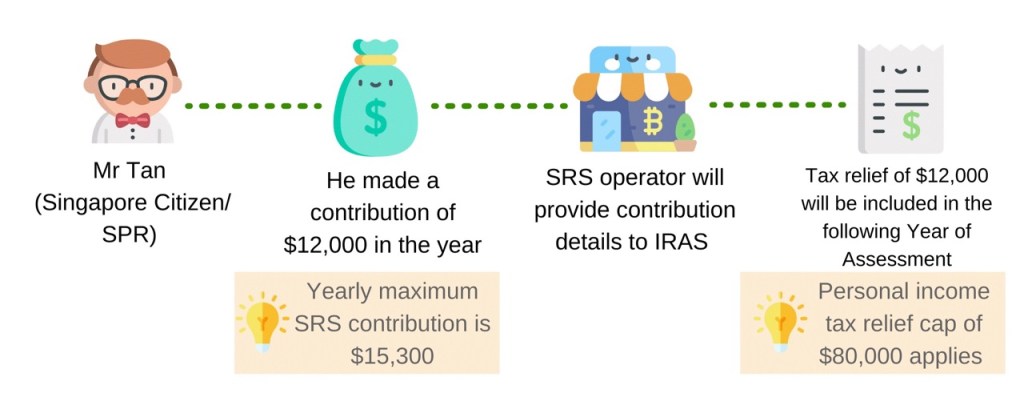
Example of SRS. Source: IRAS
When does SRS make the most sense?
- If you’re in a higher tax bracket (generally above 15%), SRS helps reduce annual income taxes while you build your retirement fund.
- It’s ideal when you don’t expect major income sources at retirement, ensuring minimal taxes on withdrawals.
- It works best when you actively invest the tax savings instead of keeping them idle.
- It offers diversification for expat retirement Singapore, allowing you to complement global investments with a locally regulated scheme.
However, if you plan to keep working or earn substantial income during retirement, you may face higher taxable withdrawals, which could offset earlier tax gains. Thus, SRS is most beneficial for those expecting a lower income at retirement or planning a phased withdrawal strategy.
Used strategically, SRS can become a cornerstone of your retirement planning Singapore, combining tax efficiency, flexibility, and long-term financial security, all essential for a stable and confident retirement journey.
3. Secure Healthcare Coverage
In Singapore, healthcare is high-quality but can be expensive, especially for retirees who no longer have employer coverage. Ensuring you have the right healthcare protection in place is essential for both financial security and peace of mind.
For expat retirement Singapore, having adequate medical insurance is particularly important since you may not qualify for local healthcare subsidies. Start by reviewing your current policies and identifying any gaps in coverage for hospitalisation, outpatient treatment, or long-term care.

Healthcare insurance statistics in Singapore. Source: Ministry of Health, Life Insurance Association
Build a Healthcare Savings Fund
Set aside a portion of your savings specifically for future medical needs. As healthcare costs tend to rise with age, plan for annual medical inflation of around 3–5%. A dedicated healthcare fund helps you cover ongoing expenses such as check-ups, prescriptions, or specialist consultations without disrupting your main retirement income.
Ensure Comprehensive Medical Insurance
Having a strong insurance foundation is a key pillar of retirement planning in Singapore.
- Private health insurance: Choose a reputable insurer offering coverage for hospitalisation, surgery, and outpatient treatments. Many plans include international coverage, ideal for expats who travel frequently.
- Integrated or enhanced plans: Consider upgrading to a private plan that allows access to higher-tier wards or private hospitals for greater comfort and flexibility.
- Review regularly: Reassess your coverage every few years or after major life changes such as relocation, retirement, or new health conditions.
Prepare for Long-Term Care Needs
As you age, medical support may extend beyond hospital stays. Explore long-term care insurance options that provide monthly cash payouts in case of disability or chronic illness. This ensures continued financial independence and relieves potential strain on family members.
Include Preventive Health Measures
Effective retirement planning also means investing in prevention. Programmes like Healthier SG promote regular screenings, vaccinations, and lifestyle management, all of which can lower long-term healthcare costs and improve quality of life in retirement.
4. Build Passive Income
When it comes to retirement planning, building reliable passive income is one of the most effective ways to secure financial stability and independence. Rather than relying solely on savings or one-time payouts, passive income allows you to generate a steady cash flow, even after you stop working.
Passive income refers to earnings that continue to flow with minimal ongoing effort, such as from investments, interest, or rental properties. It acts as a financial safety net, allowing you to maintain your lifestyle, cover healthcare costs, and manage inflation without constantly dipping into your retirement savings.
Singapore offers a wide range of options for retirees and investors looking to earn consistent returns. Some practical choices include:
- Fixed deposits: Safe and predictable, suitable for conservative investors who prioritise capital preservation.
- Singapore Savings Bonds (SSBs): Government-backed, offering steady returns with full liquidity after one year.
- Treasury bills (T-bills): Short-term government securities that provide stable yields with minimal risk.
- Bond funds: Diversified exposure to global fixed-income assets; some portfolios, like those managed by PIMCO, offer 5.0–6.0% annual returns and monthly payouts.
- Singapore REITs (Real Estate Investment Trusts): Provide exposure to property markets and distribute regular dividends, often higher than bank deposits.
- Dividend-paying stocks: Blue-chip companies like DBS or Singtel offer consistent dividends that grow over time.
- Robo-advisors and cash management accounts: Provide easy access to automated investment portfolios designed for income generation.
- Endowment plans: Long-term insurance-linked savings products that combine protection with steady returns.
When building passive income, balance is key. Combine low-risk instruments (like bonds and SSBs) with growth-oriented options (like REITs or dividend stocks) to create a diversified and resilient portfolio.You should review your estate plan annually and after major life changes, such as marriage, childbirth, asset growth, or a beneficiary’s passing. Keeping it up to date ensures your estate is managed according to your intentions and that those who depend on you remain financially secure.
5. Plan Estate & Will
Estate planning ensures that the wealth, savings, and assets you’ve worked hard for are distributed according to your wishes, giving peace of mind to both you and your loved ones. It’s about protecting your legacy and ensuring your family’s financial stability even in your absence.
Contrary to popular belief, estate planning isn’t only for the wealthy. Everyone who owns property, investments, or personal valuables can benefit from having a clear plan. For expat retirement in Singapore, it’s even more essential since cross-border assets, differing inheritance laws, and family members living abroad can complicate the process if there’s no formal will.
Without a will, the distribution of your assets may face delays, disputes, or even end up being handled by the courts under intestacy laws. This can prevent your family from accessing funds when they need them most. Having a will in place helps you:
- Determine who inherits your assets, such as cash, investments, or property.
- Appoint guardians for minor or dependent children.
- Designate trustees or executors to manage your estate efficiently.
- Prevent family conflicts by making your intentions legally clear.
How to begin estate planning
- List your assets and liabilities. Start with everything you own and owe to determine your net estate value.
- Decide on beneficiaries. Clearly identify who should receive what portion of your estate.
- Appoint key people. Name an executor to manage your estate and a guardian if you have young children.
- Understand property ownership. The way your property is owned, sole ownership, tenancy-in-common, or joint tenancy, will determine how it can be passed on.
- Consult a legal or financial advisor. Professional guidance ensures you will comply with Singapore law and addresses assets you may hold overseas.
BlueAlpha Capital – Your Retirement Planning Advisory In Singapore
BlueAlpha Capital empowers expats in Singapore to plan their retirement with clarity and confidence. Through an intelligent, data-driven approach, we transform complex financial details into a personalised roadmap that reflects your lifestyle, goals, and future ambitions.
Our secure digital platform visualises your wealth trajectory, models real-life scenarios, and adapts to market or life changes with ease. Supported by proactive advisory insights, your retirement plan stays aligned, efficient, and future-ready.
With BlueAlpha Capital, your financial journey towards retirement becomes seamless, strategic, and built for lasting peace of mind. Book a consultation with us now!