Education Savings Plan Singapore: How Much To Fund For Future Education
Published:


Key Takeaways
- A well-structured education savings plan Singapore helps parents and expats systematically prepare for rising tuition costs, ensuring children can access quality education without financial strain or debt.
- Tuition fees for expat students in Singapore can range between S$25,000 – S$27,000 annually, and even higher for specialised courses. Early child education planning helps manage these rising costs and future living expenses effectively.
- When saving for university for child, endowment plans provide guaranteed returns and protection, while regular savings plans offer flexibility and higher growth potential. Starting early maximises compounding and reduces monthly savings pressure.
Why Is Child Education Planning Necessary?
A child education plan is a long-term financial planning strategy that helps parents systematically save and invest to fund their child’s future studies. It forms part of a family’s broader financial roadmap, ensuring that education goals are met without straining daily finances or long-term savings.
In Singapore, child education planning has become increasingly vital. The cost of higher education continues to rise, and tuition for international universities can exceed S$200,000–S$300,000 when including living and travel expenses.
For expat families, this challenge is even greater due to fluctuating exchange rates, limited access to local subsidies, and the possibility of relocation before their child completes school.

A university in Singapore. Source: VnExpress
A well-structured education savings plan Singapore addresses these challenges by helping families:
- Prepare financially: Starting early spreads costs over time, easing the pressure when tuition payments begin.
- Secure quality education: Early planning ensures funds are available for both tuition and additional costs such as textbooks, enrichment programmes, and overseas living expenses.
- Avoid unnecessary debt: With disciplined savings and investment growth, parents can prevent borrowing at high interest rates.
- Gain peace of mind: Knowing you’ve set aside sufficient funds allows you to focus on your child’s development, not on financial stress.
Read more: Financial Planning for Expats in Singapore: A Complete Roadmap
How Much You’ll Need To Fund Your Child’s Education Savings Plan
University In Singapore Fees (For Expats)
When preparing an education savings plan Singapore, it’s important to understand how university fees differ for citizens, permanent residents, and expats. In Singapore, university tuition costs are heavily influenced by the Ministry of Education (MOE) Tuition Grant, which provides subsidies based on nationality. Singapore citizens receive the highest subsidies, followed by permanent residents, while international and expat students pay the highest tuition rates.
For the 2025 academic year, international or expat students studying at local universities can expect to pay between S$25,100 and S$27,650 per year (including GST) for most undergraduate programmes at universities such as NUS, NTU, and SMU. Courses in Business, Computing, and Humanities fall within this range, while specialised programmes such as Medicine can cost significantly more, up to S$181,150 for the full 5-year degree.
Here’s a quick overview of typical 2025 tuition fees for international students in Singapore:
- National University of Singapore (NUS): S$25,100–S$27,650 annually for general degrees; Medicine around S$181,150 total.
- Singapore Management University (SMU): Around S$25,100–S$27,650 per year for ASEAN and other international students.
- Singapore University of Social Sciences (SUSS): Varies by credit load, but non-subsidised fees are substantially higher.
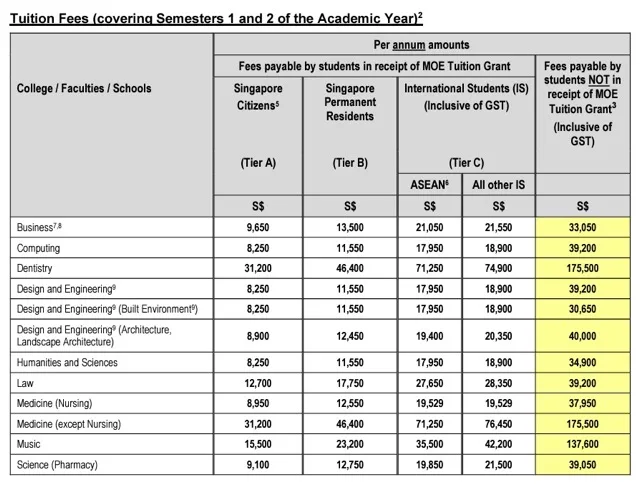
A tuition fee of NUS for term 24/25. Source: TutorRoll
Beyond tuition, parents should budget for living expenses averaging S$10,300 per year, or roughly S$41,000–S$45,000 for a four-year degree. This includes accommodation, transport, food, and personal expenses.
The financial difference between subsidised and non-subsidised education is substantial. For instance, a Singapore citizen may pay between S$22,500 and S$54,000 for a four-year degree, while an international student without a tuition grant could spend S$121,000–S$182,000, nearly three times more.
When To Start & The Cost Breakdown: Endowment Plan vs Regular Savings
When it comes to child education planning, time is your greatest advantage. The earlier you begin, the less financial strain you’ll face later. Starting an education savings plan Singapore when your child is young allows you to spread out contributions, grow returns through compounding, and stay ahead of inflation.
Two of the most common ways to save for university for your child are through Endowment Plans and Regular Savings Plans (RSPs), each offering different levels of stability, flexibility, and potential returns.
| Feature | Endowment Plan | Regular Savings Plan (RSP) |
| Purpose | Structured savings with guaranteed returns and insurance protection | Flexible investment plan focused on market growth |
| Returns (Est.) | 2–3% p.a. (guaranteed + non-guaranteed) | 4–6% p.a. (market-dependent) |
| Risk Level | Low – Capital guaranteed at maturity | Moderate – Subject to market fluctuations |
| Flexibility | Fixed premiums, less liquid | Adjustable contributions, high liquidity |
| Time Horizon | 10–20 years | 5–20 years |
| Best For | Parents seeking stable growth and disciplined saving | Parents comfortable with risk, seeking higher long-term returns |
| Example Outcome (15 yrs) | S$500/month → ~S$108,000 | S$300/month → ~S$78,000 |
Endowment Plan: Structured Savings with Protection
An endowment plan is a long-term insurance-linked savings product designed to help parents systematically build an education fund. Premiums are paid monthly or annually, typically over 10–20 years, and the plan provides both guaranteed and non-guaranteed returns upon maturity.
Key advantages:
- Discipline and consistency: Automatic premium deductions enforce regular saving habits.
- Guaranteed capital: You’ll receive at least the guaranteed maturity value, shielding your savings from market volatility.
- Protection benefits: Many plans offer coverage riders—ensuring your child’s education fund is protected even if unforeseen events occur.
For example, assuming you invest S$500 per month for 15 years at an average return of 2.5% per year, your endowment plan could accumulate about S$108,000, enough to fund a local university degree with room to spare for living expenses.
Regular Savings Plan: Flexibility with Market Exposure
A Regular Savings Plan (RSP) allows you to invest fixed amounts into unit trusts, ETFs, or mutual funds on a monthly basis. It leverages dollar-cost averaging, which helps smooth out market volatility over time.
Key advantages:
- Flexibility: You can adjust or pause contributions based on financial circumstances.
- Higher potential returns: RSPs can achieve 4–6% annualised returns over the long term, depending on market performance.
- Liquidity: Funds can be withdrawn at any time without major penalties.
For instance, if you invest S$300 per month for 15 years at a 5% return rate, your fund could grow to approximately S$78,000, giving you more flexibility for tuition, overseas study, or future inflation.
Expert Guide To Education Savings Plans in Singapore for Expats
Every parent dreams of giving their child the best start in life, but turning that dream into a clear financial plan takes guidance and foresight. That’s where BlueAlpha Capital comes in.
We help expat families in Singapore map out a smart, flexible strategy for education savings – from forecasting tuition costs to balancing investments and long-term goals. Our digital tools show how each financial decision today shapes your child’s opportunities tomorrow.
We are BlueAlpha Capital, we are the partner you are investing in your child’s future with confidence, clarity, and purpose. Talk to our financial advisor now!
Related Post: