Singapore Pension: Definition, CPF vs SRS, Retirement Schemes
Post date:


Key Takeaways
- Singapore’s pension system is built on two main pillars: CPF (Central Provident Fund) for citizens and PRs, and SRS (Supplementary Retirement Scheme) for residents and foreigners. Together, they provide structured savings for retirement, housing, and healthcare.
- While CPF is mandatory for locals, SRS serves as the key Singapore pension for foreigners, offering tax relief, flexible contributions, and diverse investment options, making it an essential part of retirement planning for expats in Singapore.
- For expats navigating CPF and SRS, partnering with a specialist like BlueAlpha Capital ensures your international pension plans are integrated, tax-efficient, and aligned with your global lifestyle and long-term financial goals.

Understanding CPF (Central Provident Fund)
What Is CPF (Central Provident Fund)?
The Central Provident Fund (CPF) is Singapore’s national pension and social security system, designed to help citizens and Permanent Residents (PRs) meet three key lifelong needs: retirement, housing, and healthcare.
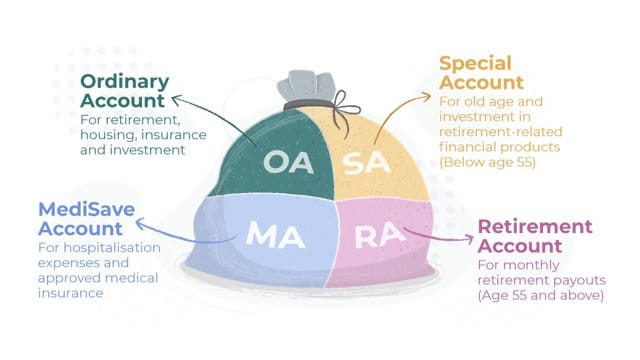
CPF operates as a mandatory savings scheme funded by both employers and employees. Each month, a portion of your salary is automatically channelled into different CPF accounts, the Ordinary Account (OA), Special Account (SA), and MediSave Account (MA), all serving specific purposes:
- Ordinary Account (OA): Used for housing, insurance, investments, and part of your retirement savings.
- Special Account (SA): Dedicated to old age and investment in retirement-related financial products, earning higher interest.
- MediSave Account (MA): Reserved for hospitalisation and approved medical insurance premiums, ensuring healthcare coverage throughout your life.
CPF offers several advantages over private pension systems: it is government-backed, low-risk, and earns guaranteed interest rates (up to 6% p.a. for older members). It also helps individuals integrate housing, healthcare, and retirement planning into one structured system.
CPF For Non-Residents or Permanent Residents
Foreigners working in Singapore are not eligible to contribute to CPF. However, once they obtain Permanent Resident (PR) status, CPF contributions become mandatory, following the same rates as Singaporean citizens (with a phased contribution schedule in the first two years).
If a foreigner later gives up PR status or leaves Singapore permanently, they can withdraw their CPF savings in full, subject to approval by the CPF Board.
This makes CPF both a compulsory savings tool for residents and a conditional retirement scheme for foreigners who choose to settle in Singapore long-term.
How CPF Works
CPF operates on a defined contribution system, meaning both the employer and the employee contribute a fixed percentage of the employee’s monthly wages, applicable from 1 January 2025, for monthly wages above S$750.
For example, workers aged 55 and below contribute 20%, while employers add 17%, bringing the total to 37% of the employee’s monthly wage. These contributions are automatically credited into individual CPF accounts.
| Employee’s Age (Years) | Employer Contribution (% of Wage) | Employee Contribution (% of Wage) | Total CPF Contribution (%) |
| 55 and below | 17 | 20 | 37 |
| Above 55 to 60 | 15.5 | 17 | 32.5 |
| Above 60 to 65 | 12 | 11.5 | 23.5 |
| Above 65 to 70 | 9 | 7.5 | 16.5 |
| Above 70 | 7.5 | 5 | 12.5 |
How To Use CPF
For local Singaporeans, CPF gives the flexibility to manage your housing, healthcare, and retirement goals through a single integrated system
Using Your Ordinary Account (OA) Savings
The Ordinary Account (OA) is primarily used for housing, insurance, and investment. Many members use their CPF savings to buy a home or repay their housing loans, making CPF an integral part of home ownership in Singapore.
However, it’s important to maintain balance:
- While CPF can help pay for your property, keeping a portion of your OA savings untouched is wise.
- These funds can serve as a financial buffer for mortgage payments during emergencies.
- Unused OA savings continue to earn stable interest rates (up to 3.5% per annum), helping your funds grow steadily over time.
For foreigners who obtain PR status, this flexibility allows them to build both property assets and retirement savings through the CPF system, a key reason many compare CPF vs SRS when evaluating long-term investment options in Singapore.
Using Your MediSave Account (MA) Savings
Your MediSave Account (MA) focuses on healthcare protection — one of the three pillars of the Singapore pension structure. These savings can be used for:
- Hospitalisation, day surgery, and selected outpatient treatments for yourself and your dependants.
- Medical insurance premiums for national schemes like:
- MediShield Life
- CareShield Life
- ElderShield
- Or other approved private medical insurance plans that offer additional benefits.
MediSave ensures that you can pay for essential healthcare costs without dipping into your daily income. It acts as a long-term health safety net, especially important after retirement when income may slow but medical expenses often increase.
Using Your Retirement Account (RA) Savings
When you reach age 55, your Retirement Account (RA) is automatically created. Savings from your OA and SA are transferred into it to form your retirement sum, the foundation of your retirement income.
Withdrawals:
- From age 55, you may withdraw part of your CPF savings after setting aside the required Basic Retirement Sum (BRS).
- Withdrawals can be made in full or partially, and as frequently as you wish.
- However, if you do not need the funds immediately, leaving them in CPF allows them to continue earning up to 6% per annum in interest, a secure, government-backed return that compounds over time.
Monthly Payouts (CPF LIFE):
- From age 65, you can begin receiving lifelong monthly payouts through CPF LIFE, Singapore’s national annuity scheme.
- These payouts provide a steady, guaranteed income for as long as you live, offering peace of mind throughout retirement.
Housing Monetisation Options
For retirees who own property, CPF also supports several housing monetisation schemes to supplement retirement income:
- Silver Housing Bonus (SHB): Offers a cash bonus when you downsize your HDB flat, with part of the sale proceeds credited to your RA to boost CPF LIFE payouts.
- Lease Buyback Scheme (LBS): Lets you sell part of your flat’s remaining lease to HDB and receive both cash and RA top-ups, helping convert property value into lifelong retirement income.
These options align with CPF’s philosophy, turning long-term assets like housing into sustainable financial resources for your later years.
Understanding SRS (Supplementary Retirement Scheme)
What Is the Supplementary Retirement Scheme (SRS)?
The Supplementary Retirement Scheme (SRS) is a voluntary savings programme introduced by the Singapore Government to complement the CPF and encourage individuals to save more for retirement.
While CPF contributions are mandatory for Singaporeans and Permanent Residents, SRS participation is optional, open to both residents and foreigners who are not eligible for CPF.
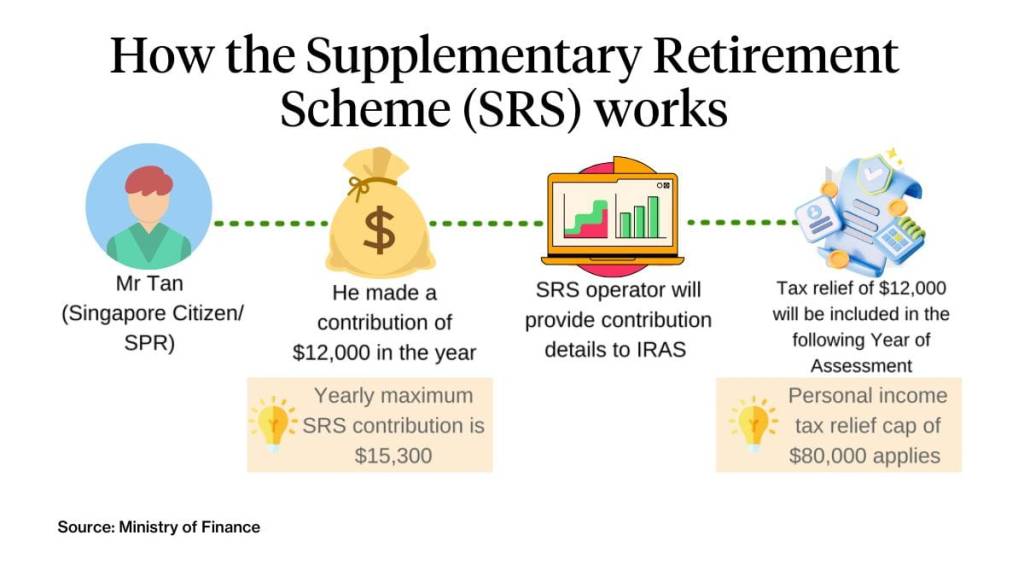
The scheme offers attractive tax benefits: every dollar you contribute to your SRS account reduces your taxable income, helping you save for the future while lowering your annual tax bill. This makes SRS an effective tool within the Singapore pension framework, especially for expats planning to stay medium to long term in Singapore.
How SRS works
SRS For Non-Residents/Expats
Unlike CPF, which is only available to Singapore Citizens and PRs, the SRS is open to all tax residents, including foreign professionals. This makes it a practical retirement savings and tax-reduction tool for expats who want to stay financially efficient during their time in Singapore.
Key benefits for foreigners include:
- High contribution limits (up to S$35,700 annually)
- Significant tax savings with each contribution
- Flexible investment choices in local and global instruments
- Option to withdraw fully after 10 years of account maintenance, if not a PR or Citizen
By leveraging SRS, expats can enjoy many of the same long-term retirement and tax advantages that CPF members receive, making SRS a powerful component of a well-rounded Singapore pension strategy.
How SRS Contributions Reduce Taxable Income
Contributing to SRS provides direct personal income tax relief. Every dollar you put into your SRS account is deducted from your taxable income, subject to annual contribution limits.
For example, if your annual income is S$60,000, your tax payable would typically be S$1,950. However, if you contribute the maximum of S$15,300 into your SRS account, your chargeable income drops to S$44,700, cutting your tax to S$879, which is a saving of more than S$1,000 in a single year.
| Chargeable Income (S$) | Income Tax Rate (%) | Gross Tax Payable (S$) |
| First $20,000 | 0 | 0 |
| Next $10,000 | 2 | 200 |
| First $30,000 | – | 200 |
| Next $10,000 | 3.5 | 350 |
| First $40,000 | – | 550 |
| Next $40,000 | 7 | 2,800 |
| First $80,000 | – | 3,350 |
| Next $40,000 | 11.5 | 4,600 |
| First $120,000 | – | 7,950 |
| Next $40,000 | 15 | 6,000 |
| First $160,000 | – | 13,950 |
| Next $40,000 | 18 | 7,200 |
| First $200,000 | – | 21,150 |
| Next $40,000 | 19 | 7,600 |
Source: IRAS
How to Open an SRS Account
Opening an SRS (Supplementary Retirement Scheme) account is simple and can be done through one of three approved banks in Singapore, DBS, OCBC, or UOB.
You are eligible to open an SRS account if you:
- Are at least 18 years old
- Are not an undischarged bankrupt
- Are mentally capable of managing your own financial affairs
- Do not already have another SRS account with any operator
Each person can only hold one SRS account. To apply, you’ll need to complete the bank’s SRS declaration form and provide valid identification such as your NRIC or passport. Once opened, you can contribute anytime during the year, either personally or through your employer.
Annual Contribution Limits:
- Singapore Citizens and PRs: up to S$15,300 per year
- Foreigners: up to S$35,700 per year
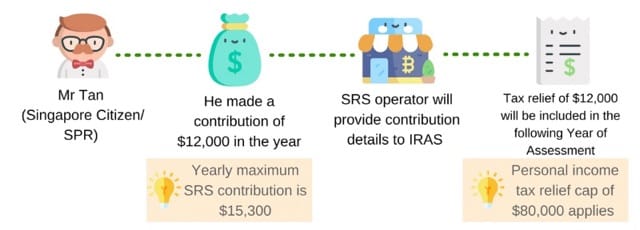
All contributions must be made in cash by 31 December each year to qualify for SRS tax relief in the following Year of Assessment.
SRS Tax Relief: Withdrawals, Penalties, and Tax Implications
Every dollar contributed to your SRS account is deducted from your chargeable income, effectively reducing your income tax.
For example, if you earn S$80,000 and contribute S$15,000 to your SRS account, your taxable income becomes S$65,000, resulting in a lower tax bracket and reduced tax payable.
Example of SRS contributions and tax relief. Source: IRAS
The tax relief limit is based on your actual SRS contribution amount, subject to the annual cap. However, note that there is a personal income tax relief cap of S$80,000, which includes all types of tax reliefs (SRS, CPF top-ups, donations, etc.).
This makes SRS particularly beneficial for foreigners and high-income professionals who are not eligible for CPF, providing a legitimate and flexible way to reduce tax liability while saving for retirement.
You may withdraw your SRS funds anytime, but the timing determines how much tax you pay.
- At or after the statutory retirement age (currently 63): Only 50% of the withdrawn amount is taxable. For example, if you withdraw S$40,000, only S$20,000 is taxed, and since the first S$20,000 of income is tax-free, you might pay no tax at all if you have no other income.
- Before retirement age: The withdrawal is 100% taxable and subject to a 5% early withdrawal penalty.
To maximise benefits, it’s advisable to spread your withdrawals over 10 years after reaching retirement age, keeping your annual taxable income lower.
Exceptions to the 5% penalty:
- Withdrawals made due to death, medical conditions, or bankruptcy
- Full withdrawal by a foreigner who:
- Has not been a Singapore Citizen or PR for the past 10 continuous years, and
- Has maintained the SRS account for at least 10 years
Singapore Pension System Comparison: CPF vs SRS
Singapore offers two key retirement schemes: the Central Provident Fund (CPF) and the Supplementary Retirement Scheme (SRS). While CPF is a mandatory national pension system for Singapore Citizens and Permanent Residents, SRS is a voluntary savings plan open to both residents and foreigners.
Understanding the difference between these two systems is essential for effective retirement planning for expats Singapore and anyone seeking to build long-term financial stability through structured savings or international pension plans.
| Category | CPF (Central Provident Fund) | SRS (Supplementary Retirement Scheme) |
| Type of Scheme | Mandatory social security savings plan | Voluntary savings and investment plan |
| Eligibility | Singapore Citizens and Permanent Residents | Singapore Citizens, PRs, and Foreigners |
| Contribution | Fixed monthly contributions by employer and employee (up to 37% combined) | Flexible cash contributions (up to S$15,300 for locals, S$35,700 for foreigners) |
| Purpose | Covers retirement, housing, and healthcare needs | Focused on retirement savings and tax reduction |
| Tax Benefits | CPF contributions are not tax-deductible; interest earned is tax-free | Contributions are tax-deductible, and only 50% of withdrawals are taxable at retirement |
| Investment Options | Limited to approved CPF Investment Scheme (CPFIS) products | Broad range — stocks, ETFs, bonds, unit trusts, and insurance |
| Withdrawal Age | Withdrawals allowed from age 55; monthly payouts start at 65 under CPF LIFE | Withdrawals allowed from statutory retirement age (currently 63); early withdrawal incurs 5% penalty |
| Withdrawal Tax | CPF payouts are tax-free | 50% of withdrawals are taxable at retirement; 100% taxable if withdrawn early |
| Interest Rate | 2.5%–6% per annum, government-guaranteed | Market-linked returns depending on investment choice |
| Flexibility | Low — fixed rules on usage and withdrawal | High — flexible contributions and investment control |
| Ideal For | Citizens and PRs seeking a guaranteed, stable pension in Singapore | Foreigners and high-income earners seeking a flexible Singapore pension for foreigners and tax-efficient savings |
In summary:
- For Singapore Citizens and PRs: CPF remains the foundation of your Singapore pension, ensuring a stable and lifelong income through CPF LIFE.
- For Foreigners and Expats: SRS offers a flexible, tax-advantaged route for retirement planning in Singapore, letting you invest, grow, and withdraw strategically even without CPF access.
- For Global Professionals: Combining SRS with international pension plans can help diversify your retirement portfolio and maximise global tax efficiency.
BlueAlpha Capital – Your Trusted Expat Pension Advisor In Singapore
If you’re an expat living in Singapore, understanding how CPF and SRS fit into your retirement plan can be confusing. CPF is designed for citizens and PRs, while SRS offers tax relief but still leaves many wondering how to turn savings into a long-term plan. Without a clear structure, it’s easy to feel unsure whether your money is working hard enough or whether you’ll have enough when you retire.
That’s exactly where the right guidance makes all the difference.
With local pension rules that don’t always cater to foreigners, having someone who understands both Singapore’s pension system and international retirement planning can help you make confident, strategic decisions.
BlueAlpha Capital helps expats like you connect every piece, CPF, SRS, and global investment options, into one cohesive retirement blueprint. You’ll gain:
- A clear, actionable plan for your Singapore pension, tailored to your lifestyle and future goals.
- Independent, expert advice on how to balance CPF and SRS with international pension plans.
- Flexible, portable solutions so your retirement savings move with you wherever life takes you.
Your financial journey in Singapore doesn’t have to be complicated. With the right support, you can make your pension work smarter, not harder. Start your retirement planning today with BlueAlpha Capital and take control of your future with clarity and confidence.